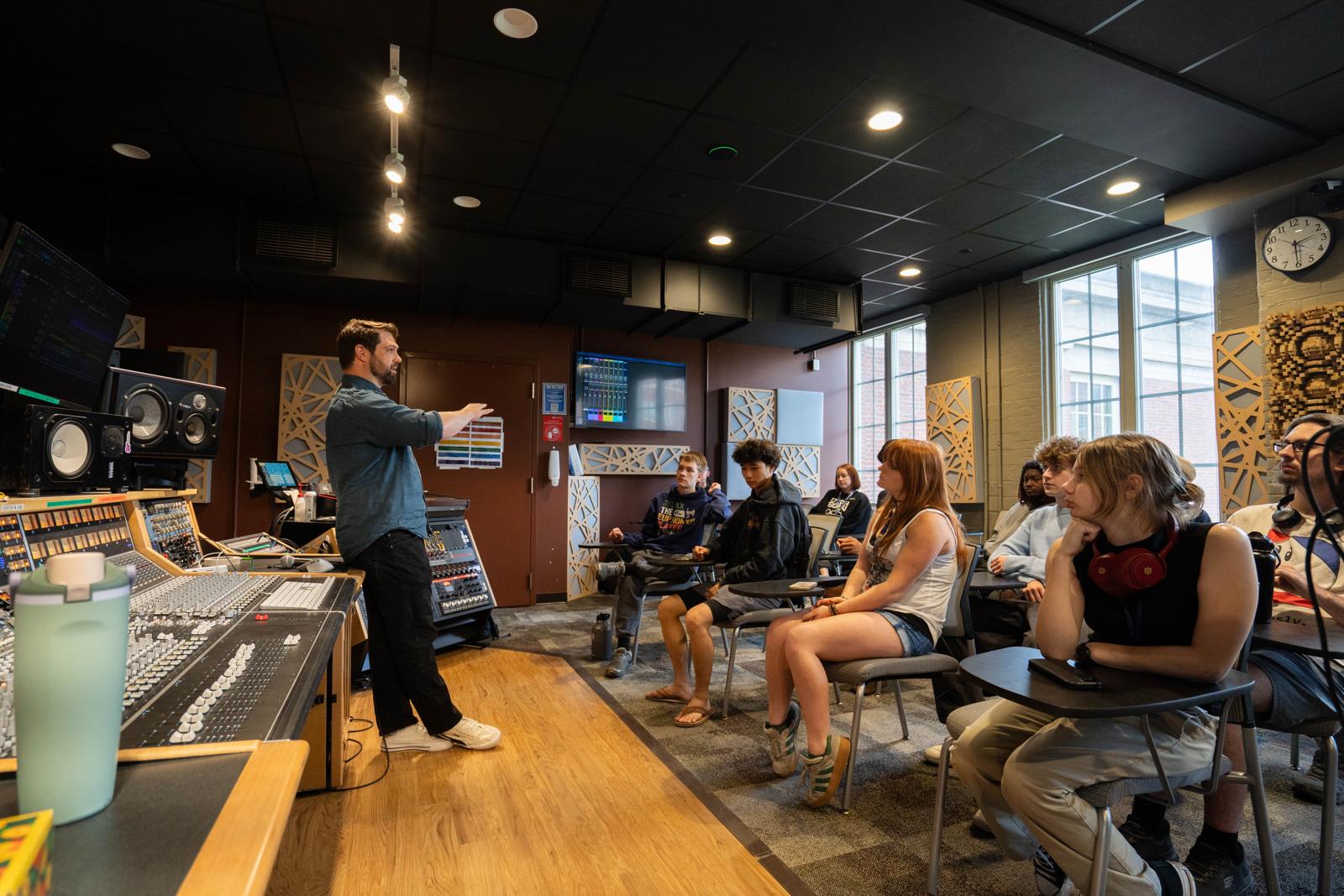

There are a lot of serious young musicians who would probably never think about applying to the Eastman School of Music.
They may spend hours every day making music but not necessarily practicing an orchestral instrument or preparing a traditional audition. They are working in Logic, Ableton Live or Pro Tools. They are writing songs, building tracks, recording themselves, manipulating samples, using MIDI controllers and synthesizers, or doing some combination of all of it. For some, the computer is as much a musical instrument as anything else in the room. Eastman thinks some of those students belong there.
Beginning in fall 2027, the school will welcome the first class in its new Bachelor of Music in Music Creation and Technology. The program is being led by Dennis DeSantis, Eastman associate professor of music and technology, composer and former head of music learning at Ableton. DeSantis is also an Eastman alumnus, having earned his Doctor of Musical Arts in composition there in 2005.
When I talked with DeSantis about the program, one of the first things I wanted to understand was how a degree like this came to exist at Eastman in the first place. “There have been various iterations of a new kind of contemporary production program happening at Eastman for a long time,” he said.
At one point, a popular music degree had been considered. DeSantis said that ultimately did not seem like the right direction for the school. What emerged instead was an idea he describes as a “genre-neutral creative music technology program.”
That is an important distinction, because it would be easy to look at the name of this degree and assume Eastman is opening a recording school or an electronic music program. It isn’t.
“Maybe the biggest difference is that this isn’t really an audio engineering program,” DeSantis said. “It’s more of a creative music production program.”
In other words, the technology is there to make music. As longtime executive director of Technology in Music Education, this is an important thing for me to hear. TI:ME has long made the case, though less so as the years go by, that technology programs are critical not only for teaching the standards of music education, but for attracting the “other 80% of students” who will never join a traditional vocal or instrumental program, or do so because it is all that is offered that even touches on their interest in making music.
Students will certainly learn the technical side. Eastman has an advantage here because it is part of the University of Rochester, and the program can draw on the Hajim School of Engineering and Applied Sciences for coursework in areas including audio engineering, programming and electronics. The new major is part of Eastman’s Department of Sound Arts and Engineering, which connects the music school with engineering resources elsewhere in the university.
But DeSantis isn’t primarily looking for an 18-year-old who can explain signal flow or give him a textbook definition of bit depth, sample rates, or explain compression vs limiting. He is looking for somebody who is already using technology creatively.
DeSantis originally envisioned selecting students from their portfolios and interviews without any sort of performance audition. Other Eastman faculty challenged that idea. Their concern was reasonable: They wanted to see some evidence of musicianship happening in real time.
DeSantis came around to their point of view, but the resulting requirement doesn’t look much like a traditional Eastman audition.
“They don’t have to audition in a conventional way on a traditional instrument, which is quite new for Eastman,” he said, “but they do have to demonstrate something.”
That “something” could be playing an instrument. It could also be manipulating a controller or processing sound live. “If it’s turning a knob and having that adjust a filter cutoff, I want to observe them do that in a musical way,” he said. DeSantis isn’t interested in whether the applicant knows where the filter knob is. He wants to know what the student does with it.
The application reflects that. Students submit three to five recordings, including original work demonstrating creative uses of technology, along with original DAW project files. There is also a reconstruction, cover or remix assignment and a video in which applicants show their music-making setup, discuss how they work and perform music from their portfolio. That performance can involve a conventional instrument, but it can also involve MIDI controllers, DJ equipment or other technology.
Applicants then interview with faculty by Zoom rather than coming to Eastman for a conventional undergraduate audition.
DeSantis told me he expects to learn quite a bit simply by opening applicants’ sessions.
“If they made the thing in a DAW, I want to hear the music, but I also want to look at the project,” he said.
Anyone who has spent much time making records knows there are about a thousand ways to organize a session, and not everybody arrives at the same result by the same route. DeSantis isn’t looking for a prescribed template. The project lets him see how the student thinks about audio, synthesis, signal flow and the process of putting music together.
“I’m not gonna have them do a test of, ‘Explain bit depth to me,’ or something,” he said.
That doesn’t mean students get to Eastman and avoid traditional musicianship. They don’t.
The degree still includes music theory, music history, piano, performance and ensemble requirements, along with the technology and engineering curriculum. That combination is really what makes the program interesting. Students still get the Eastman musical foundation, but they can arrive with a very different musical background and have access to both sides of the university.
The range of students DeSantis hopes to attract is deliberately broad. One applicant might be a traditionally trained instrumentalist who has become interested in electronics. Another might have learned primarily by producing music on a computer. There could be songwriters, electronic composers, beat makers, programmers and students building their own instruments or software.
What DeSantis does not want is a first class made up of 20 versions of the same student.
“If somehow all of the students who enter the first year have a very narrow set of musical interests,” he said, “then I think it will be clear that we did the messaging wrong.”
He wants the recruiting pool to be much wider than that.
“I want students to be excited about this, whether they’re into music X or music Y or music that we’ve never heard before.”
Eastman is also building a physical home for the program. The school has announced plans for a roughly 6,000-square-foot center with labs, classrooms, creative spaces, teaching studios and recording facilities. When DeSantis and I spoke in August, construction had not yet begun.
The facility may be new, but DeSantis points out that Eastman students have been experimenting outside their formal coursework for years.
DeSantis made that point when I asked whether introducing this much open-ended creative work represented a dramatic cultural change for Eastman.
“Very interesting things happen here, often student-led,” he said. “Unusual chamber ensembles pop out of this school all the time, and the kinds of music that the kids are listening to and making outside of their traditional coursework with each other is often the next thing.”
He remembers it from his own time there.
“I was a student here 20 years ago,” he said. “And wild things were happening then.”
What is different now is that Eastman is putting some of that experimentation into an actual degree program.
DeSantis described it as trying, in some ways, to “put that back into an institutional program.” He also knows perfectly well that once students arrive, they are going to do things nobody writing the curriculum anticipated.
“The students are going to take it into a hundred other directions that only they will conceive of,” he said. And this is the part that should get the attention of every music educator reading SBO+.
We all know students whose musical lives don’t fit neatly into the programs we traditionally offer them. A student can spend three hours producing a track at home and still not think of himself or herself as the kind of musician who goes to music school. Some are already in band, orchestra or choir. Others aren’t. Their musical education may have come from YouTube, friends, experimentation and thousands of hours spent figuring things out because they wanted to make something they could hear in their heads.
Not long ago, a student like that could look at Eastman and reasonably conclude, “That’s not for me.” This program gives that student a reason to take another look.
What I personally find appealing about that is the students who come in for this program, maybe begin to explore other traditional avenues for making music. They are not mutually exclusive, and in the 21st century musicians need to know how to make recordings as much as recording engineers need to understand how music is actually made. It can be a wonderful symbiosis.
There is still an obvious question for families looking at any new music degree: What does somebody do with it when they graduate?
The truth is that there isn’t one job title attached to this degree. DeSantis sees possibilities in composition, performance, production, education, audio engineering, playback engineering, music technology and product development. Some graduates may build companies. Others will probably combine several of those things.
That is already normal in the professional music business. Plenty of us have made careers by doing several things at once, and the combination changes over time, your intrepid reporter included.
It also makes more sense to me than training somebody around one piece of software. Software changes. Companies disappear. Entire production methods come and go. A student who understands music, sound, technology and how to solve creative problems has something considerably more durable.
The first class arrives in fall 2027, and applications for that class are happening now.
DeSantis doesn’t know exactly what those students will create when they get to Rochester. How could he? Part of the idea is to bring together young musicians who approach music in completely different ways and see what happens.
“The students are going to take it into a hundred other directions that only they will conceive of,” he said.
Good. Let them. At SBO+, we are excited to help document the evolution of music education, and Eastman is definitely evolving.
SBO+ salutes you, Eastman.
More info: https://www.esm.rochester.edu/go/soundarts/music-technology/