


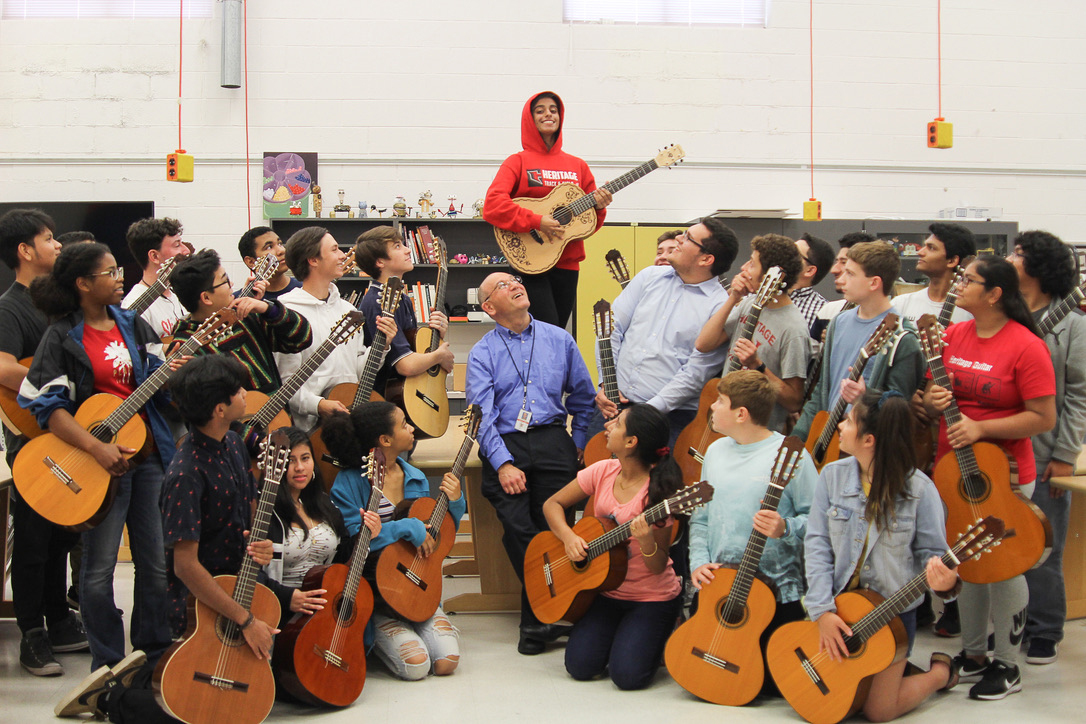





As a midwestern band director, Shemeka Nash has a very typical workload: overseeing beginning, intermediate, and advanced concert bands, as well as the marching band and jazz band at the school. But what sets her apart from many in the region is the role students take in these ensemble offerings—reshaping the repertoire, feel, instrumentation, and more in the image of their own cultural identities and personal preferences—an innovation she attributes to the influence of modern band, which she also offers as part of her program’s ensemble roster. She leverages her modern band and this student-centered approach, not only as a way to motivate more students to participate in music, but also as a way of facilitating students’ personal development, allowing them to make decisions throughout the music-making process, and by extension, learning about themselves and developing critical social and interpersonal skills.
As an 18-year veteran teacher, Nash has taught modern band for the past 11 years in Chicago Public Schools, ever since she attended the first modern band workshop offered in Chicago in 2009. With an already budding concert band program, she saw the inclusion of modern band as a way to give more students who didn’t see themselves as musicians the opportunity to engage in music at their school on the far southside of Chicago. “I’m getting kids in my room that wouldn’t normally be here, because getting the chance to play instruments like guitars and basses was something completely new for them,” she says, though she is quick to dispel the idea that the culturally responsive pedagogy of modern band compels students to quit their more traditional ensembles. “I haven’t lost any students in my band program to the modern band.” Nash suspects that this is because students are allowed to participate in both ensembles, with each offering the time to work on different skills. One prime example is one of her lead concert band students. “When I opened up the (modern band) ensemble for any students to participate, my lead euphonium player said that she could sing. She showed up and started singing all of these Bruno Mars songs! We ended up doing a Bruno Mars medley and she became the lead singer.” Yet despite her new place in the modern band, the student’s enthusiasm for concert band never wavered.
Why allow her students so much agency in their music-making? The answer, according to Nash, is authenticity—a concept she wants her students to understand and live by, from being genuine about their musical choices and expression to owning and embracing their own voices, thoughts, and opinions. This idea is central to her approach with all of her ensembles. “You know, as a band director, I always try to put on a pops concert, but it doesn’t always sound as authentic, due to the arrangement being published with a different key, instrumentation, and so on, and the students feel it. I think that as educators, we need to give our students authentic experiences in our classrooms to keep them engaged.” While she continues to allow space for some popular genres in her concert and marching band repertoires, she now mostly reserves that music for her modern band ensemble, and to great success: the ensemble, whose name, “1744,” was taken from the address of the school, has performed at notable Chicago venues such as The Metro as part of Little Kids Rock’s JamFest series, the Back to School Kickoff Concert at the Pritzker Pavilion in Chicago’s Millennium Park—the largest public stage in the city—and other events in support of their school, performing incredible arrangements of student-selected repertoire by artists such as Mars, Michael Jackson, and Destiny’s Child.
Nash enjoys giving her modern band students more flexibility by providing them with these choices. But, she admits, trusting this process was initially daunting. “Giving my kids more decision-making ability was the hardest part for me, with my marching band and concert band background,” she recounts. The key, in her estimation, is that students must have some fundamental skills before they’re ready to make those decisions. “In addition to learning the repertoire they would want to play, we do some basic warm-ups, which include learning their chromatic scales, improvising on their instruments, and singing the roots of the chord progressions.” In addition, she has the students learn how to play and memorize root movement around the circle of fourths. She does this so that her students know their way around their chosen instrument and can speak more fluidly about it when the time comes to make key musical decisions. “Learning the circle of fourths is key, since we see it happen in lots of popular music,” she says. “This continues to develop their ear when analyzing music.” She explains that these warm-ups were taken from her experience as a jazz band director, but lent themselves perfectly to this pursuit of getting modern band students comfortable with their instruments.
Once students are prepared to effectively play their instruments, the music-making starts with the arranging process. “The students find live performances of the songs they would like to perform,” she says. “[They] bring in YouTube videos or live recordings of different performances and make artistic choices deciding on the instrumentation, and variances in the groove, keys that best fit our vocalists, and others.”
Nash’s experiments with student-centered pedagogy have recast her students as collaborators in the creative process and help them feel proud to present their choices onstage. More importantly, though, they have given her students life opportunities they often don’t find at school or anywhere else—to express themselves, to experience a sense of empowerment, and to exhibit ownership over a small piece of their world.
Joe Panganiban is formerly the senior director of programs at Little Kids Rock and is currently the program officer of arts learning at the Lloyd A. Fry Foundation.
Braeden Henderson is the senior manager of community outreach at Little Kids Rock.