

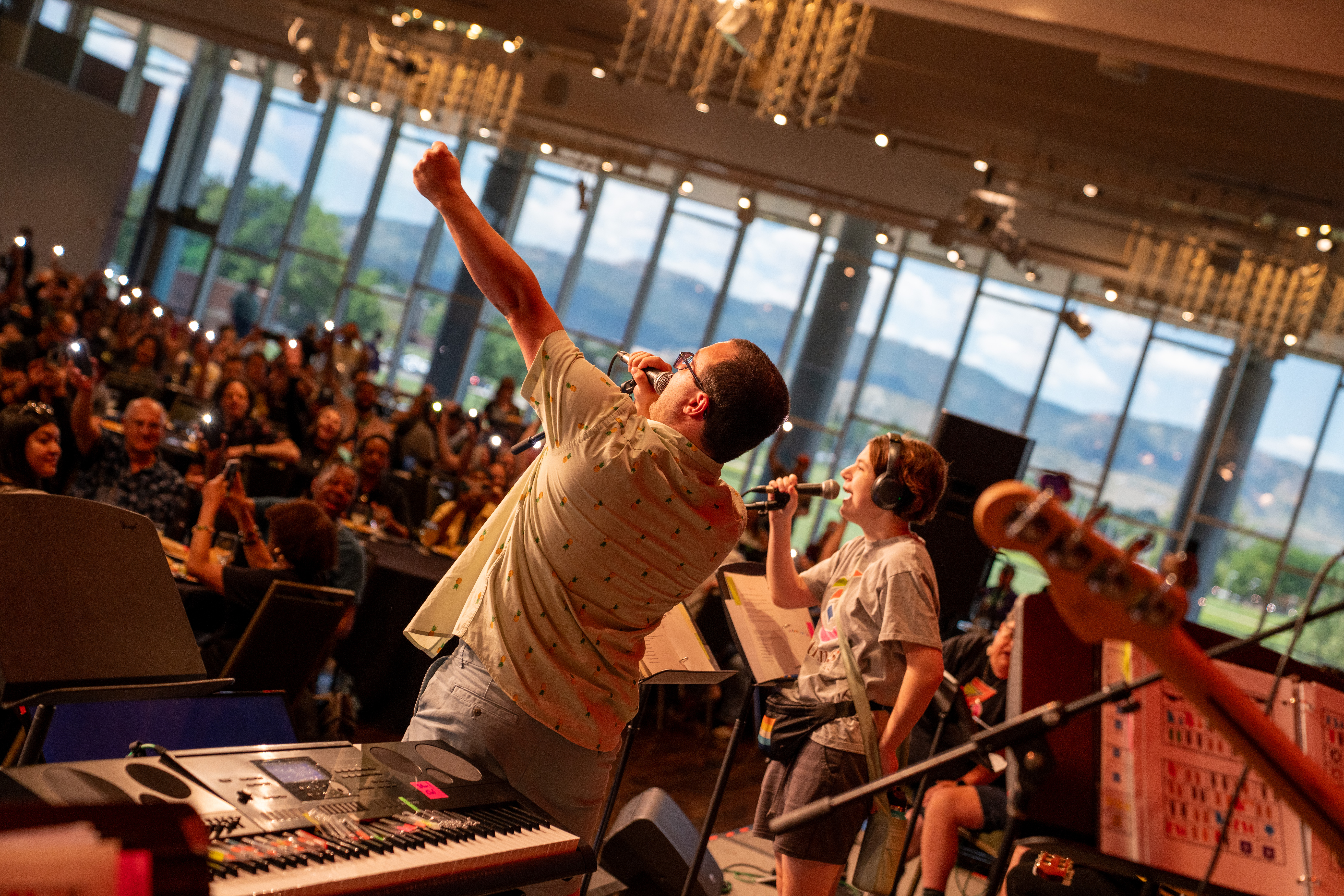


 In my teaching practice overall, I have alluded to the following five core learning values: whole-body, social, personalized, language-based, and creative. I espouse these same values when it comes to the details of leading a big band program. An example of whole-body learning in this context might involve harnessing the aural and kinesthetic aspects of building repertory. Learning certain pieces “by ear,” for example, can bridge the gap for certain styles (often contemporary) where published arrangements don’t exist. It also creates flexibility where instrumentation deviates from the norm. Students are put into the driver’s seat for aural transcription of their individual parts; in cases of written scores, they are encouraged to memorize and play “off book” as much as possible. Whatever the source, vocalizing parts and employing movement in rehearsal can help “embody” the score, especially at the phrase and counterpoint levels, and encourage an “eye-ear” ensemble dynamic in live performance.
As the flagship ensemble representing jazz in most universities, the big band can benefit the community by highlighting the social context out of which the genre grew. Programming that allows for at least one social dance event annually is something that can bring people together in a truly participatory fashion. It’s fascinating in these moments to see how audience participants draw instant connections between music of past and present, through dance and other forms of social engagement. And the performers in turn feed off that energy and are taught valuable lessons in showmanship and being in the “now.”
Personalization of learning in a big band presents challenges in time management, but there are several methods that I’ve used successfully. One method is a system of rotating leaderships – this can include a student leading the whole ensemble in a warm-up activity, or students taking turns leading their own sectional (usually tune by tune).
Creative methods to ensure all students improvise is also key to their understanding the whole arrangement. Usually this involves call and response, trading 4s/8s, collective improvisation, and/or breaking down open sections to feature a subset of instruments.
The best methods I can employ to ensure students in big band acquire language – germane to different jazz styles – are those which help them situate that music culturally and socio-historically. This could mean assigning guided listening, background research on pieces/players/composers, and open journal responses. Hearing musical expression at the phrase level as signifying blues, bebop, gospel, or modal language exposes students to pathways toward creating new phrases that build on these traditions… and performing written lines with conviction.
Finally, it is paramount that directors sell big band as a fundamentally creative activity. The aforementioned efforts toward inclusivity in improvisation is a necessary ingredient, but by no means the only tool available. Students can and should be encouraged to be part of the conversation in curating repertory and concert themes, and some may even be well-positioned to arrange or compose. Allowing for all to be equal stakeholders in event production is itself a creative activity, as are efforts toward recording, cross-disciplinary and multimedia collaboration, where possible. Ultimately, the best proof of creative success is the big band being able to faithfully execute – yet make each performance distinctive and memorable. This can only be achieved through living the music on many levels, so one is able to respond to its vicissitudes in performance – a hallmark of professionalism.
 Matthew Steckler (aka Matty Stecks) performs and composes in several musical settings internationally. His recordings with projects Dead Cat Bounce, Persiflage and Musical Tramps – on Ropeadope, Cuneiform and Innova labels – have made Best CD lists in DownBeat and Jazz Times. Steckler has taught at Brandon University, RPI, NYU, and K-12 schools; led clinics across North America; and presented research at Jazz Education Network and College Music Society conferences. His latest release with group Persiflage is available to listen via Bandcamp: