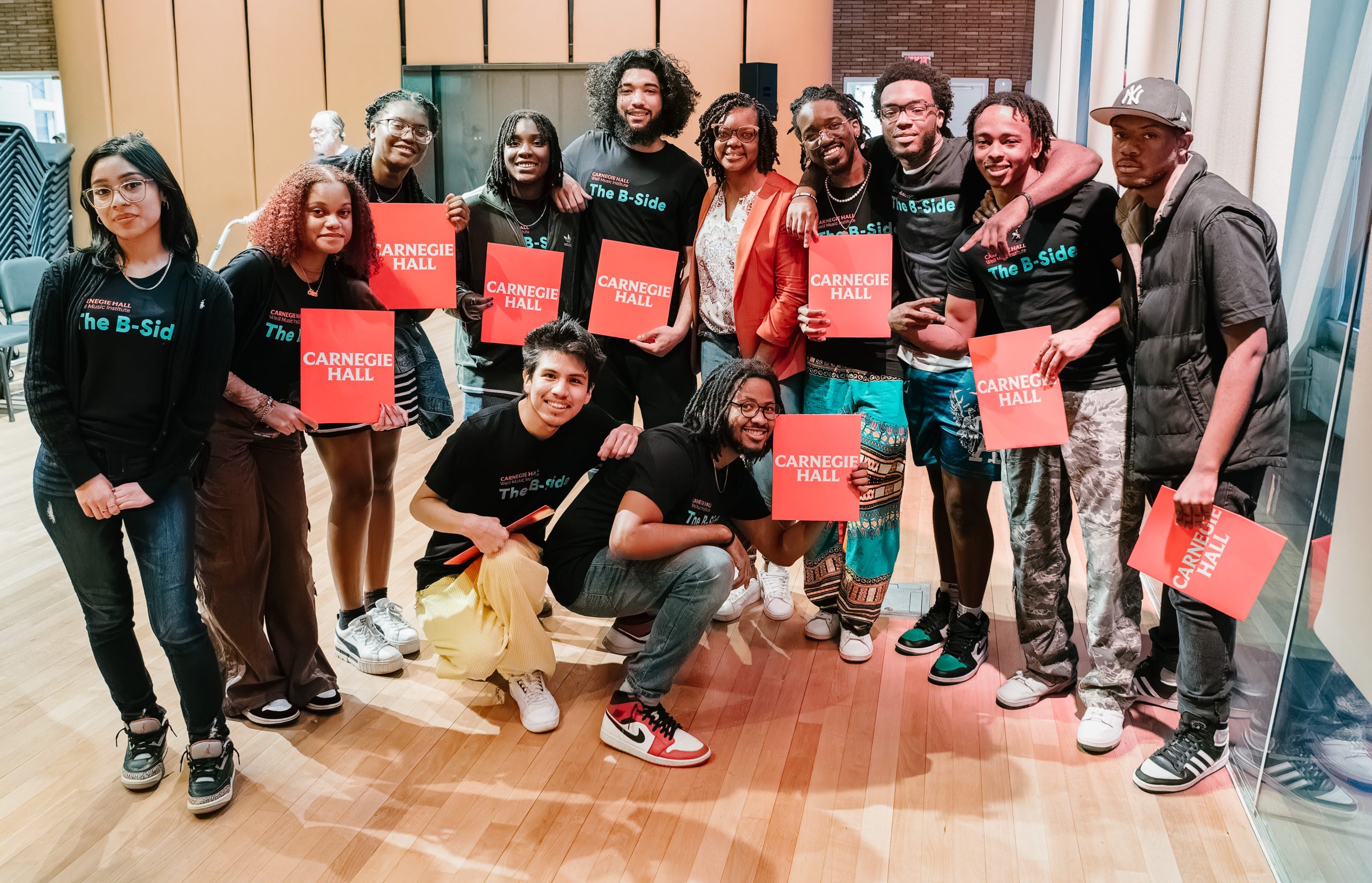










In November 2022, Carnegie Hall’s Weill Institute of Music announced a new youth-focused pilot program, titled “the B-Side.” The program is intended to introduce youth to many of the business functions in the music industry. Each of these functions also present future career opportunities for performers and non-performers, both instrumental and vocal.
Planning and preparation for this new offering was deliberate and disciplined. Two pilot focus groups of the potential audience group of young musicians were conducted this year. These were limited to New York City attendees. Twenty student musicians, ages 14 to 17, attended a February 11-18, 2023, session. A second session of older students took place in April. The purpose of these was to identify topics, interest level, and current level of knowledge in the business side of the music industry. An earlier brain-storming planning session worked with local music industry business leaders to determine the business areas they felt needed to be included.
Learning objectives of these sessions included student exposure to and appreciation of the overall music industry. This includes understanding what an artist’s team requires to execute efficient and effective projects, gain an insight into their own strengths and sharpen their research and critical thinking skills. The program participants experienced real-life in the professional working spaces of various specialties, networking with local industry professionals including asking direct questions about that specific career path.
Boyle outlined Carnegie-Weill’s overall long-range B-Side plan. “The first phase of the B-Side provides an overview of some of the key roles and departments found in a record label production. This beginner curriculum focuses on exposure to career paths while also providing opportunities for young people to cultivate their skills in networking, collaboration, and career readiness. As the B-Side grows we will develop additional curriculum targeting specific roles, skills, and education necessary to be successful in those roles. We also will look to develop specific related support such as skills in applying for internships and jobs as well as navigating the actual workplace.”
B-Side’s origin included input from industry consultants who accumulated potential music industry roles and topics. Each day’s topics focused on the different functions and departments and people that make a project or performance possible and successful. The course would include guest speakers who work in these real-world industries. The course goal was to de-mystify the numerous music industry careers and provide possible entry points for these students. Whether artistic, administrative, promotional, legal, financial, or even a blend of these, the students could approach these careers with a real and current understanding of what is required.

None of the many books or a variety of earlier and current specific educational efforts provide the early direct exposure of music students with working members of the various relevant business activities and careers like Carnegie’s B-Side.
Reflecting on the importance of the B-Side, I remembered my own experience. After years of activity as a student musician including school and college orchestras, concert and marching bands, big band, combos and even a drum and bugle corps, I was forced to learn the business side of music through a college activity.

The University of Florida had a student-staffed lyceum council which selected, contracted, and produced an annual series of six on-campus music performances by major national musical groups and soloists. As business manager of this council, I executed the contracts, made all venue arrangements such as seating, crowd access and security, parking, as well as sound and lighting systems, developed and distributed promotional materials, prepared tickets as well as providing both box office and stage staffing. All under the watchful eye of the dean of students since the council operated with student funds from the university. The council’s concerts included artists such as Satchmo (Louis Armstrong), classical pianist Leonard Pennario, the Philadelphia Orchestra, and others of similar national importance and prominence.
The call came from the dean of students about an unusual opportunity that required quick action and response. He had been contacted by the booking agent of the then very popular Kingston Trio. They were touring southern college campuses and had an open date. The dean had advised them that this year’s schedule was set, and all our funds were committed. They responded that we “might make it work” and wanted to talk. That negotiation became my assignment and ultimately my education. The Kingston Trio did appear at the Florida Gymnasium to an enthusiastic audience of thousands of students and residents of the surrounding area. This, with a hastily drafted contract with no minimum fee but just a percentage of gate receipts. The council’s portion of these receipts allowed expansion of the following year’s concert schedule.

Likewise, lessons about union labor contracts came from a confrontation with the Teamsters Union over the handling of the Philadelphia Orchestra’s truckload of instruments and other support equipment that accompanied their concert appearances. Knowledge of the state laws regarding union contracts on state university campuses and the campus enforcement options was critical to a quick onsite resolution.
No part of my lengthy and extensive music education and participation had prepared me for any of these critical and necessary activities.

While this Carnegie-Weill pilot program came with an emphasis of educational offerings for BIPOC (black, indigenous and people of color) students, it addresses the needs of all music students to become aware of the many broad non-performing career paths in music. Associated are the many skills that are necessary to be successful in those careers.
One B-Side student summed up their experience saying, “we got so much information in context of what really goes on inside labels of the music industry and how you can be successful in those fields. The day in the music studio really brought us into the life of a regular artist or participant that’s really doing this for their job every day.”
Questioned about national, or even regional, rollout of similar sessions, Boyle stated, “Not at this time! Our plan is to take our time to collect feedback and reflections from our team as well as the February and April pilot program participants.” Future B-Side plans are for a continued on-site, New York City area only, offering next spring at Carnegie Hall, “exact dates to be determined” said Meg Boyle, Carnegie Hall’s manager of public relations.
Books About Non-Performing Music Industry Careers
There are several books that address non-performing music industry careers. These resources can provide valuable and helpful information to music educators in guiding their students.
Borg, Booby and Eames, Michael, Introduction to Music Publishing for Musicians, MusicPro guides, 2021, Focus is primarily on publishing and its related fields. It also contains a resources list and end-of-chapter quizzes.
Borg, Bobby, The Musician’s Handbook, Billboard Books, 2008, Focus is on the relationships between performing musicians and the other various necessary music businesses.
Braheny, John, The Craft and Business of Songwriting, Writer’s Digest Books, 2001, Outlines all the functions important to a songwriter with a list of resources.
Crouch, Tanja L., 100 Careers in the Music Business, Barron’s Educational Series, 2008, A number of appendices resources including organizations, directories and magazines, colleges offering four year music business management degrees, and more.
Gerardi, Robert, Opportunities in Music Careers, VGM Career Horizons, 1997, Lists a number of associated professional organizations, other “extended career choices” that include teaching, musicologist, music librarian, music critic, music therapy, religious and military music and careers about the music equipment such as the manufacture, repair of instruments and electronics.
Weisman, Loren, Music Business for Dummies, John Wiley & Sons, 2015, Primarily focuses on the roles directly involved with the musical performance environment.