
A cupboard full of percussion instruments can still leave a lesson short of the sound it needs. Before choosing another assortment, name the musical job: a clear pulse, a short accent, a sustained color, a pitched pattern, or a contrast students can control.
That description makes a purchasing conversation more useful. A dealer can demonstrate a sound and its playing technique; the teacher can decide whether students can use it for the intended task.
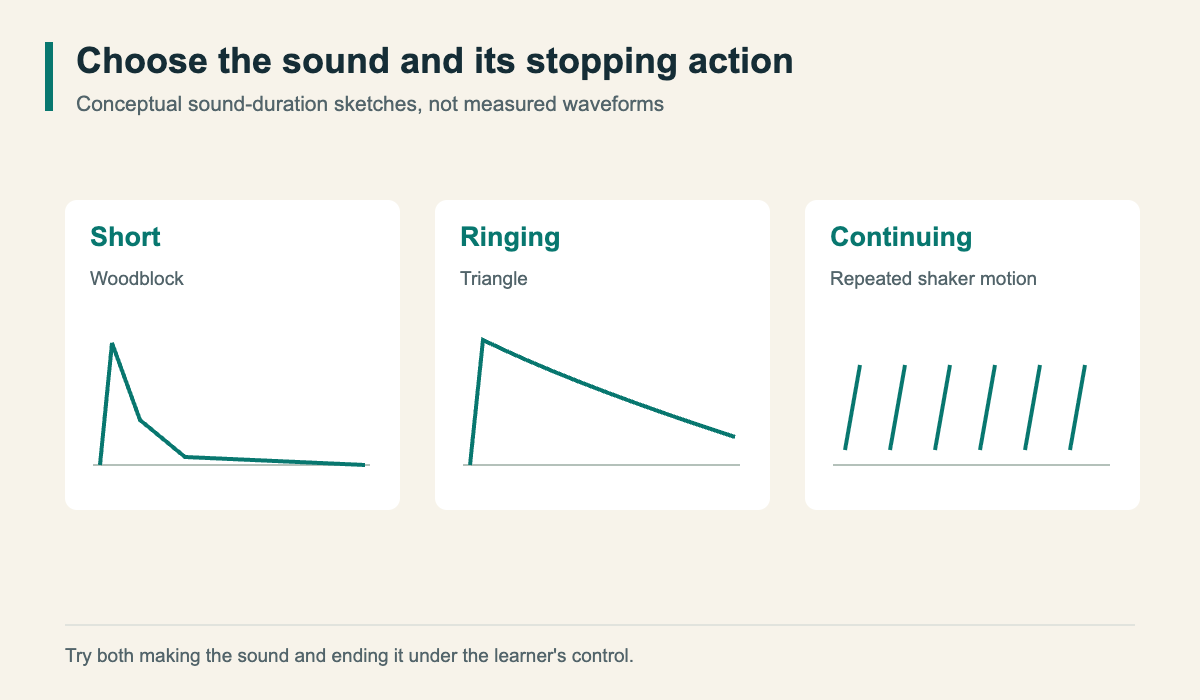
Separate duration from volume
A struck woodblock supplies a short sound. A triangle can ring after the strike, and its duration changes when the player damps it. A shaker can sustain an ongoing texture through repeated movement. These are different musical resources even when all three can be heard clearly in the room.
Ask students to create a four-beat pattern with a short sound, then repeat it with a ringing sound. Have them identify what changes when the instrument continues sounding through a written rest. The instrument's decay and the student's choice to damp it become part of the lesson.
For buying, request a demonstration of both sounding and stopping the instrument. A sustained sound is only useful for a precise ending when the learner can control that ending.
Try the actual playing action
An instrument that an adult can operate easily may demand too much grip, reach, or repeated movement from a child. Let the intended player try it where practical, or reproduce the expected playing position and support.
Consider whether the instrument can rest on a surface or stand, whether a mallet can be held comfortably, and whether a learner can stop the sound independently. A larger instrument is not automatically more accessible; a smaller one is not automatically easier to control.
When planning alternatives, preserve the musical role. A learner keeping the pulse with an accessible pad or supported instrument should still be able to hear how that part joins the group.
Choose beaters as part of the sound
Mallet hardness, contact point, and stroke affect the result. Use beaters intended for the instrument and follow its maker's guidance. Avoid treating every available stick as interchangeable, particularly on tuned bars and delicate surfaces.
Ask the dealer to include the appropriate beaters in the demonstration and quote. Identify replacements before the original pair goes missing. Label storage so a substitute teacher can find the intended combination without guessing.
Plan a small ensemble before buying a large one
For a short classroom piece, choose three contrasting roles: a dependable pulse, a repeating pattern, and a limited number of accents or sustained colors. Rotate students through the roles so no instrument becomes a permanent reward or holding job.
Listen in the actual room if possible. Give students a way to play with controlled dynamics and clear starts and stops. Larger quantities of the same bright instrument may not improve balance or participation.
For pitched percussion, check available pitches against the repertoire and planned activities. Confirm whether chromatic bars, stands, cases, and replacement parts are included or separate.
Include the cupboard in the purchase
Measure the storage space and the route from storage to teaching area. Ask how the instrument is cleaned, which surfaces or parts need special care, and how it can be carried securely. Use the manufacturer's cleaning guidance rather than applying one chemical to every material.
The final comparison sheet should list musical role, player fit, controlled sound and silence, included accessories, storage, care, and replacement support. Price belongs on that sheet, but it should describe the complete usable setup.
A useful purchase arrives with a lesson already in view and a clear place to go when the lesson ends.