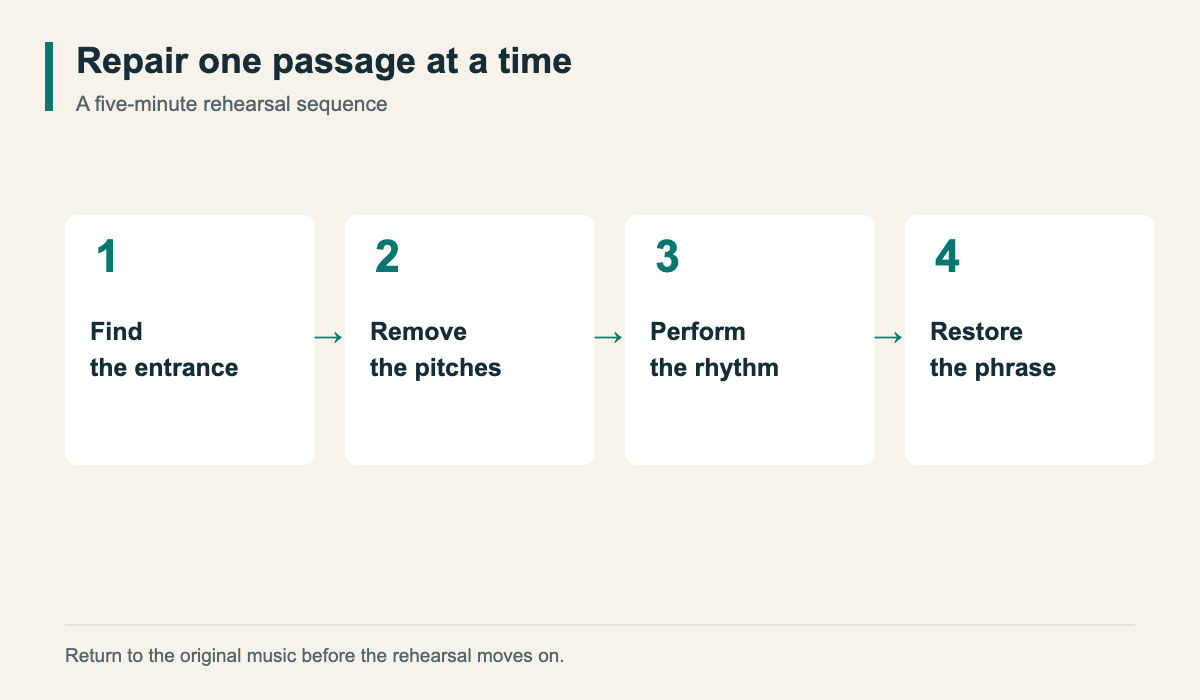
When concert time is close, a full run can reveal the same rhythmic problem several times without giving students a way to fix it. Take five minutes out of the run and make one small task unmistakable.
Choose a troublesome measure, strip away the pitches, and decide what you need to hear. "The entrance after the rest lands on beat four" is a useful target. "Play it better" leaves everyone guessing.
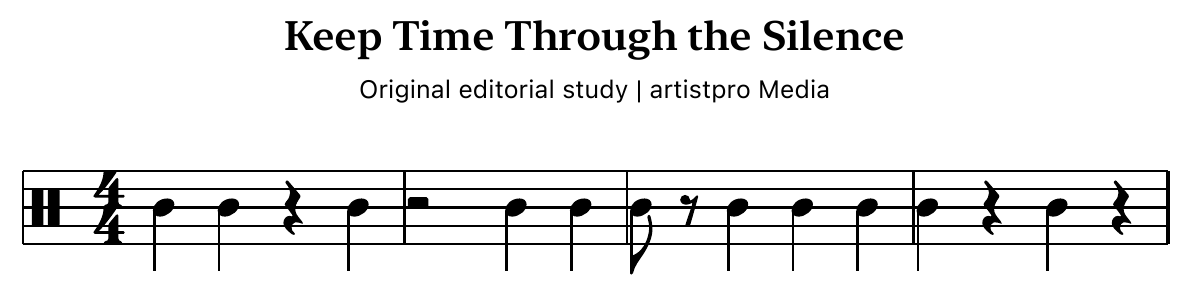
The five activities below use the same four-measure rhythm study supplied with this article. Transfer the successful activity back into the repertoire before the rehearsal ends.
The missing beat
Use measure one: two quarter notes, a quarter rest, and a quarter note in 4/4. Have students tap the pulse while speaking the attack points: "one, two, [silent three], four." Keep the motion going on three. Then remove the speech and perform the pattern.
Ask a listening group to watch only the return on four. If the entrance is late, repeat at a tempo where the group can prepare it. If it rushes, make the silent beat visible again. Finish with the original measure from the concert piece.
The two-beat bridge
Use measure two, with its half rest on beats one and two. Pair students. One performs while the other quietly marks the four-beat pulse. The performer must enter on three without an extra cue.
Switch roles, then have both perform while imagining the partner's pulse. The partner's role is to supply a reference, not to pull the performer into the entrance. Ask where the performer began preparing to play again.
The half-beat gap
Use measure three. Count eighth-note subdivisions slowly enough that each part of the beat is distinct. Clap the first eighth note, leave its partner silent, and enter on beat two. Students can point across eight boxes as they speak the subdivisions.
Then play the rhythm on a single comfortable pitch. If the instrumental version falls apart, check whether breath, bow change, sticking, or finger preparation is adding a second problem. Keep that technical issue separate from recognition of the rhythm.
The relay
Assign each measure of the study to a different group. Everyone tracks all four measures, but each group sounds only its own. On the next pass, change the assignments. Students should enter because they know where they are in the phrase, not because the teacher turns toward them.
Keep the first attempt short. An unsuccessful relay is information: it can show that students follow their own notes well but lose their place when listening to someone else.
The changed measure
Perform the study twice. On the second pass, replace measure four with a student-created measure totaling four quarter-note beats. Limit the available vocabulary to values the class has already learned. A classmate reads the new measure before its composer explains it.
If the reader performs something different from what the composer intended, compare the notation and the explanation. Revise the measure, not the classmate. Composition becomes a precise check on rhythmic understanding.
End where the music began
Return to the concert passage immediately. Play enough of the surrounding phrase that the repaired measure has a musical entrance and destination. Ask students whether the same solution survived the return of pitch, articulation, and dynamics.
Record one sentence for the next rehearsal: the measure, the problem, and the activity that helped. Five focused minutes should leave the ensemble with a repeatable method, not just a better attempt while the teacher is counting.