
A convincing demonstration answers the demonstrator's question. A useful school purchase answers yours. Before you reach a booth, write one sentence describing the musical work you want students to do.
For example: "Beginning players will identify where a four-measure phrase loses pulse, practice the transition, and perform it again without the device." That sentence gives a metronome, practice platform, notation program, or recording tool something specific to prove.
The 2027 NAMM Show takes place January 26-30 in Anaheim, with exhibits January 28-30. Check the organizer's current schedule and registration information when planning attendance. The evaluation method below also works for a dealer visit or an online demonstration.
Bring a small, familiar task
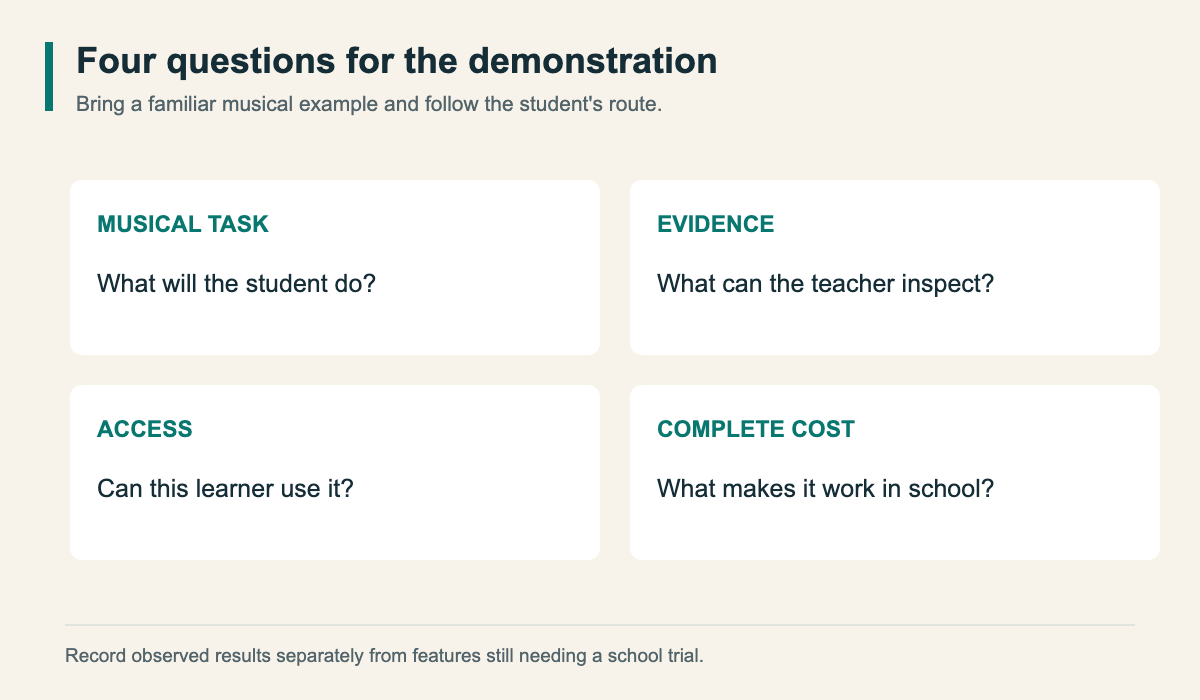
Take a short musical example you have permission to use. Choose something whose notes, rhythms, and intended result you understand. A spectacular prerecorded demonstration may be enjoyable, but your example will show whether the tool can handle a problem your students actually face.
Ask the demonstrator to work through that task. Record which steps you can perform yourself, which require assistance, and which are unavailable in the demonstrated version. Keep the version or model name with your notes.
Follow one student's route
Begin where the student begins: opening the tool, getting the material, making a response, saving it, and returning later. Count on the conditions in your classroom. Note the device, connection, peripherals, and account type used in the demonstration.
If your class uses managed Chromebooks, a result on a different computer does not establish compatibility. Ask for documented requirements and a trial under the school's actual conditions. Treat features you have not tried as questions to answer, not as promises to repeat to colleagues.
Ask what you will be able to assess
Look for the musical evidence you need. Can the teacher inspect the student's notation, choices, revisions, or performance? Can students explain what changed? Does the tool's score represent the objective you are teaching, or only a narrower action such as matching an input?
For a creative task, follow one idea from draft to final version. Ask how the work can be exported and what remains available if a subscription ends. If a feature generates material, distinguish the student's source work from the generated contribution.
Try an alternative response
Have the demonstrator show a second way to complete the task: keyboard rather than pointer, a readable enlarged view, captions or text for spoken instructions, or another response relevant to your students. Record the actual result rather than checking a generic accessibility box.
Ask how a student can participate when an account, device, connection, age condition, or school approval prevents use. A workable alternative should pursue the same musical objective, even if it uses paper, an instrument, or another service.
Price the whole teaching arrangement
List licenses, renewal terms, required hardware, replacement items, staff preparation, support, and the time needed to set up a class. Keep quotes dated and identify what they include. A show price is not automatically the cost of maintaining the program.
School privacy, procurement, and technology teams can resolve their respective requirements using the vendor's current documentation. Bring back the documents and the unanswered questions; do not infer approval from a friendly booth conversation.
Return with one testable recommendation
Describe the proposed use, the evidence seen, the limits observed, and a small classroom trial. A trial should name the musical task and what would justify continuing.
The strongest report from a trade show may be a modest one: one tool, one clear purpose, and a convincing account of what students will be able to do.