





• Latest
  • Trending
Teaching by Ear, Learning by Heart Creative Musical Arts at New England Conservatory – Part III

Teaching by Ear, Learning by Heart Creative Musical Arts at New England Conservatory – Part III

April 8, 2024
The Start of an Era

The Start of an Era

April 1, 2026
New Products

New Products

April 1, 2026
ADVERTISEMENT
Minute Clinic

Minute Clinic

April 1, 2026
Music, Art, and Awe

Music, Art, and Awe

March 26, 2026
Principles for Building Stronger Classroom Systems

Principles for Building Stronger Classroom Systems

March 24, 2026
How a Long-Term Vision Can Transform Your Ensemble

How a Long-Term Vision Can Transform Your Ensemble

March 23, 2026
Performance Practices for the Concert March

Performance Practices for the Concert March

March 20, 2026
Fine-Tuning the Foundation

Fine-Tuning the Foundation

March 20, 2026
WindTalkers

WindTalkers

March 18, 2026
America’s Musicians

America’s Musicians

March 16, 2026
NAfME Neighborhood

NAfME Neighborhood

March 13, 2026
Tone Deaf Comics

Tone Deaf Comics

March 12, 2026
Thursday, April 2, 2026
  • Contact
SBO+
  • Advertise
  • Subscribe Free!
    • Manage Subscription
  • Departments
    • Choral
    • String Section
      • String Section
    • Concert Band
    • Modern Band
      • Mariachi
    • Orchestra
    • Instruments
      • Woodwinds
        • Wind Talkers
      • Percussion
        • GoodVibes
      • Repertoire
      • Playing Tips
    • Marching Band
    • Resources
      • Fundraising
    • Jazz
    • Brass
    • General Music
    • Advocacy
      • NAfME Neighborhood
      • MAC Corner
      • MusicEd: Mentor Minute
    • Commentary
      • Bubbett’s Bookshelf
      • Leadership Tips
      • Perspective
      • InService
        • America’s Bandmasters
        • America’s Musicians
      • Tone Deaf Comics
    • Features
    • News
      • Headlines
  • Current Issue
    • Past Issues
  • Support
  • Awards/Entries
    • 50 Music Teachers who Make a Difference
    • Teachers’ Choice Awards Nominations
No Result
View All Result
  • Advertise
  • Subscribe Free!
    • Manage Subscription
  • Departments
    • Choral
    • String Section
      • String Section
    • Concert Band
    • Modern Band
      • Mariachi
    • Orchestra
    • Instruments
      • Woodwinds
        • Wind Talkers
      • Percussion
        • GoodVibes
      • Repertoire
      • Playing Tips
    • Marching Band
    • Resources
      • Fundraising
    • Jazz
    • Brass
    • General Music
    • Advocacy
      • NAfME Neighborhood
      • MAC Corner
      • MusicEd: Mentor Minute
    • Commentary
      • Bubbett’s Bookshelf
      • Leadership Tips
      • Perspective
      • InService
        • America’s Bandmasters
        • America’s Musicians
      • Tone Deaf Comics
    • Features
    • News
      • Headlines
  • Current Issue
    • Past Issues
  • Support
  • Awards/Entries
    • 50 Music Teachers who Make a Difference
    • Teachers’ Choice Awards Nominations
No Result
View All Result
SBO+
No Result
View All Result

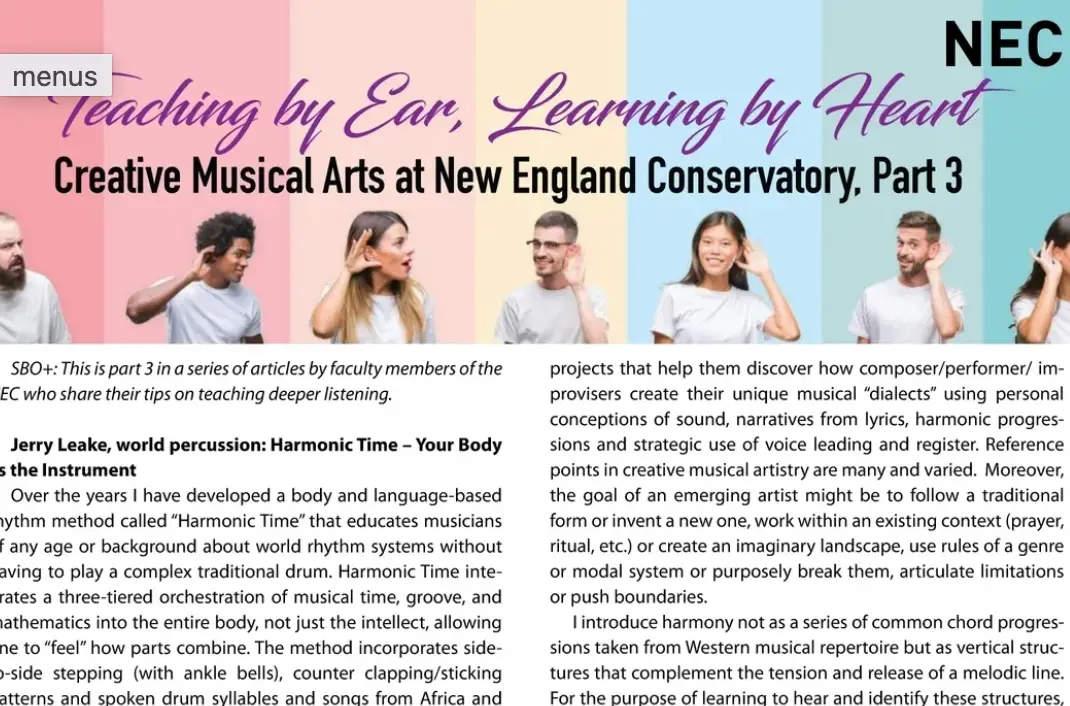
Teaching by Ear, Learning by Heart Creative Musical Arts at New England Conservatory – Part III

April 8, 2024
in Archives, Commentary, April 2024
Share on Facebook
Sweetwater
ADVERTISEMENT

SBO+: This is part 3 in a series of articles by faculty members of the NEC who share their tips on teaching deeper listening.

Jerry Leake, world percussion: Harmonic Time – Your Body as the Instrument

Over the years I have developed a body and language-based rhythm method called “Harmonic Time” that educates musicians of any age or background about world rhythm systems without having to play a complex traditional drum. Harmonic Time integrates a three-tiered orchestration of musical time, groove, and mathematics into the entire body, not just the intellect, allowing one to “feel” how parts combine. The method incorporates side-to-side stepping (with ankle bells), counter clapping/sticking patterns and spoken drum syllables and songs from Africa and India. This “language-based” model, drawing on aural/oral traditions, allows one to practice rhythm away from their instrument, strengthening short and long-term memory skills while developing coordination and independence. From young children to professional musicians, practitioners discover the power and depth of rhythm using a “theory meets practice” approach to composition, improvisation and, most importantly, education.


Dr. Hankus Netsky, Co-Chair CMA: NEC’s Contemporary Musical Arts Curriculum as a Template for Teaching Creative Musical Artistry

As a longtime teacher, I’ve developed a project-based aural skills curriculum that starts with detailed listening to the music of major creative musical artists. In doing so, I draw from the teachings of our founding chair, Ran Blake, who calls this practice developing “Long-Term Melodic Memory.” Over the years we’ve drawn our departmental repertoire from recordings by singers Billie Holiday and Abbey Lincoln, recordings of Bollywood pop and Greek protest songs, compositions by Stevie Wonder, George Russell and Dmitri Shostakovich, and from folk and popular performers of many diverse nationalities. When using such recordings as springboards the student will naturally want to consider the intention of the performer and/or composer. What emotions does the performer and/or composer seek to express in the piece? What are the characteristics of the performer’s gestural language? What story are they trying to convey? And most importantly, what are the specific and unique signifiers of the culture the music comes from? Whatever the answers to these questions, my goal in using classic recordings as texts has always been to push the student to realize expressive and creative melodic, harmonic and rhythmic invention is something a lot of cultures can agree is important – and that cannot be expressed effectively through notation.

After basic melodic work, students take on detailed listening projects that help them discover how composer/performer/ improvisers create their unique musical “dialects” using personal conceptions of sound, narratives from lyrics, harmonic progressions and strategic use of voice leading and register. Reference points in creative musical artistry are many and varied.  Moreover, the goal of an emerging artist might be to follow a traditional form or invent a new one, work within an existing context (prayer, ritual, etc.) or create an imaginary landscape, use rules of a genre or modal system or purposely break them, articulate limitations or push boundaries. 

I introduce harmony not as a series of common chord progressions taken from Western musical repertoire but as vertical structures that complement the tension and release of a melodic line.  For the purpose of learning to hear and identify these structures, I place a pedal point on the top and work downward from there since, in my experience, harmony is usually heard in relation to a melody and not so much in relation to a figured bass, the approach still most used in teaching harmony. Confident the student has mastered melodic intervals while working on melodies (they’re another important component of the curriculum), I start this process by introducing harmonic intervals. Next, I introduce triads working downward through two harmonic intervals and then I add a bass note. By the end of a student’s second semester, they become fluent in recognizing and notating seventh chords of all types and, by the end of their third semester, they’re fluent in recognizing many different common and uncommon vertical sonorities containing up to six or seven pitches.  

Along with their work on chord recognition, I expect all students to memorize actual pieces of music that use harmony, register and chord voicings in innovative ways and perform them on the piano. I draw these from the recorded repertoire of creative musical icons including pianist Jimmy Yancey, singer/pianist Nina Simone, pianist/composers Thelonious Monk and Duke Ellington and bassist/composer Charles Mingus. I give out no lead sheets or manuscript versions of pieces for students to study. Of course, our students are also required to demonstrate proficiency in transcription, something we incorporate into our curriculum at every level.  If students can’t figure out a piece with larger harmonic structures, I give them easier pieces to figure out.

In the context of a conservatory education, it has often seemed to outsiders that our department is one of the most innovative programs out there but, from a more objective viewpoint, our program might be the most traditional one. Learning through oral tradition likely predates learning through notation by at least five-hundred thousand years(!). Empowering our students to learn the way great musicians of all traditions have learned from time immemorial is the greatest gift we music teachers can give them.

NECmusic.edu

You may also like:

2012 ’50 Directors Who Make a Difference’ Report SBO Presents The 19th Annual 50 Directors Who Make A Difference The 22nd Annual 50 Directors Who Make a Difference Vote Now for 2014 Best Tools for Schools SBO Presents the 18th Annual 50 Directors Who Make A Difference Report
Bob Rogers Travel
ADVERTISEMENT
Rovner
ADVERTISEMENT

POPULAR STORY

  • New Products December 2025

    New Products December 2025

    1785 shares
    Share 714 Tweet 446
  • Holiday Gift Guide for Music Businesses: Tools to Boost Engagement and Growth

    1712 shares
    Share 685 Tweet 428
  • 50 Music Teachers Who Make a Difference

    1410 shares
    Share 564 Tweet 353
  • When Selecting New Choral Music, Choose Success

    1299 shares
    Share 520 Tweet 325
  • 2025 Teachers’ Choice Award Winners

    1184 shares
    Share 474 Tweet 296
AFAG Messen und Ausstellungen GmbH
ADVERTISEMENT

SchoolMusic.Travel

No articles found.
Next Post
Composing for Middle and High School Choirs – A conversation with Laura Farnell and Reginald Writer – Part 1

Composing for Middle and High School Choirs - A conversation with Laura Farnell and Reginald Writer - Part 1

  • April 2026

    Articles | Digital Issue
  • March 2026

    Articles | Digital Issue
  • February 2026

    Articles | Digital Issue
  • January 2026

    Articles | Digital Issue
  • December 2025

    Articles | Digital Issue
© 2005 - 2026 artistpro, LLC
7012 City Center Way, Suite 207
Fairview, Tennessee 37062
(800) 682-8114

No Result
View All Result
  • Advertise
  • Subscribe Free!
    • Manage Subscription
  • Departments
    • Choral
    • String Section
      • String Section
    • Concert Band
    • Modern Band
      • Mariachi
    • Orchestra
    • Instruments
      • Woodwinds
      • Percussion
      • Repertoire
      • Playing Tips
    • Marching Band
    • Resources
      • Fundraising
    • Jazz
    • Brass
    • General Music
    • Advocacy
      • NAfME Neighborhood
      • MAC Corner
      • MusicEd: Mentor Minute
    • Commentary
      • Bubbett’s Bookshelf
      • Leadership Tips
      • Perspective
      • InService
      • Tone Deaf Comics
    • Features
    • News
      • Headlines
  • Current Issue
    • Past Issues
  • Support
  • Awards/Entries
    • 50 Music Teachers who Make a Difference
    • Teachers’ Choice Awards Nominations

© 2005 - 2024 artistpro, LLC 7012 City Center Way, Suite 207 Fairview, Tennessee 37062 (800) 682-8114

Wenger Transcend Ad
Wenger Transcend Ad