




• Latest
  • Trending
Teaching the Craft of Musical Composition

Teaching the Craft of Musical Composition

March 13, 2023
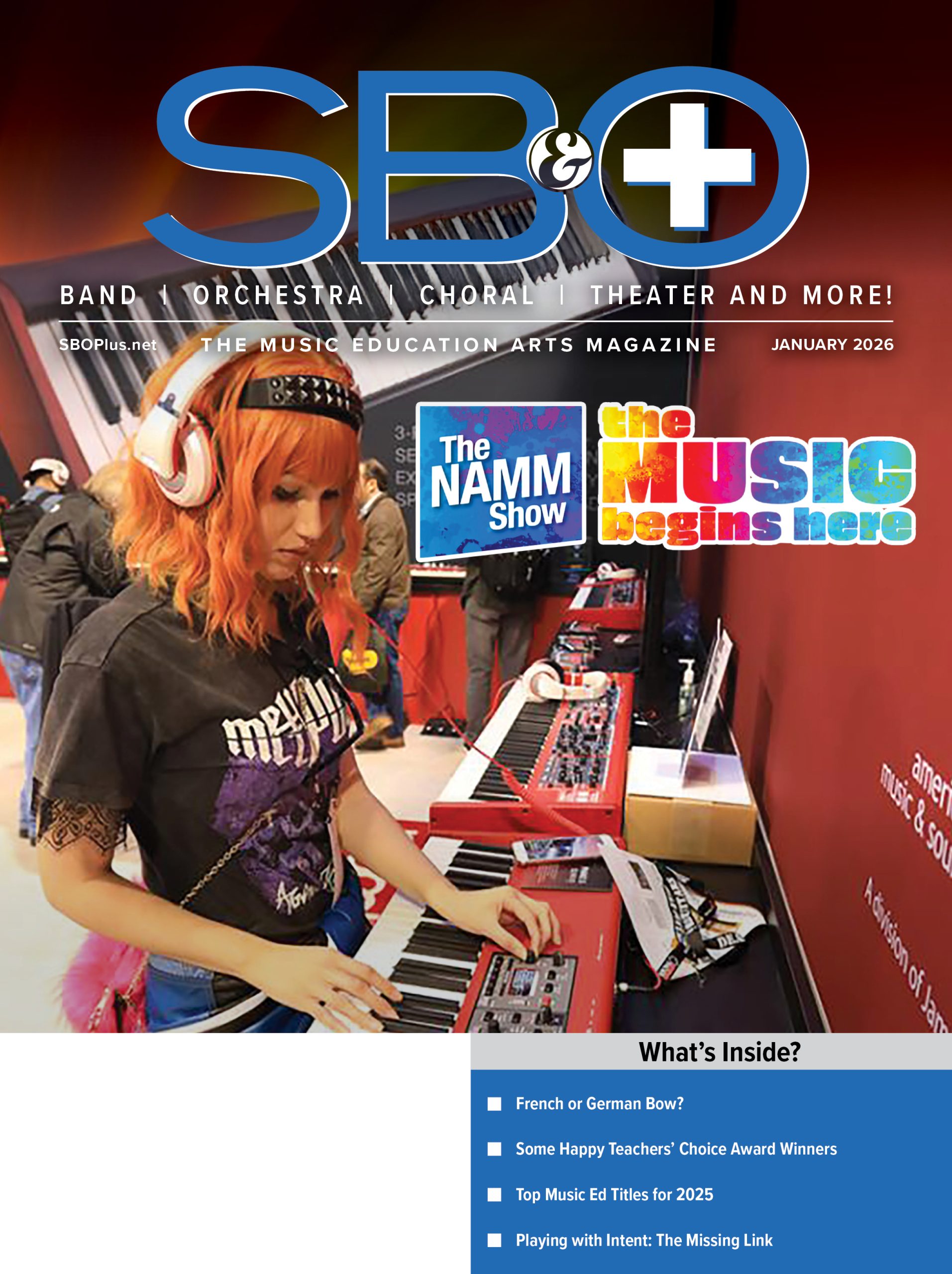
NAMM Show 2026 – A Can’t Miss Event

NAMM Show 2026 – A Can’t Miss Event

January 6, 2026
BEGINNING BAND

BEGINNING BAND

December 30, 2025
Sweetwater Instrument Rentals
New Products December 2025

New Products December 2025

December 30, 2025
Musical Detective: Why? When? How?

Musical Detective: Why? When? How?

December 22, 2025
Holiday Gift Guide for Music Businesses: Tools to Boost Engagement and Growth

Holiday Gift Guide for Music Businesses: Tools to Boost Engagement and Growth

December 21, 2025
The Perfect Culmination: How One Violinist Found His Calling in the U.S. Air Force Strings

The Perfect Culmination: How One Violinist Found His Calling in the U.S. Air Force Strings

December 19, 2025
The Road Ahead for Music and Arts Ed: Keeping it Human

The Road Ahead for Music and Arts Ed: Keeping it Human

December 29, 2025
The Power of Small School Music Programs

The Power of Small School Music Programs

December 29, 2025
Rehearsal AI: Transforming Artificial Intelligence into Authentic Musical Intelligence

Rehearsal AI: Transforming Artificial Intelligence into Authentic Musical Intelligence

December 15, 2025
Crafting a Creative Mindset for Band – Part 2

Crafting a Creative Mindset for Band – Part 2

December 14, 2025
Headlines December 2025

Headlines December 2025

December 30, 2025
Turn Rejection Into Success

Turn Rejection Into Success

December 10, 2025
Wednesday, January 7, 2026
  • Contact
SBO+
Excelcia Music Publishing
  • Subscribe Free!
    • Manage Subscription
  • Departments
    • Choral
    • String Section
      • String Section
    • Concert Band
    • Modern Band
      • Mariachi
    • Orchestra
    • Instruments
      • Woodwinds
        • Wind Talkers
      • Percussion
        • GoodVibes
      • Repertoire
      • Playing Tips
    • Marching Band
    • Resources
      • Fundraising
    • Jazz
    • Brass
    • General Music
    • Advocacy
      • NAfME Neighborhood
      • MAC Corner
      • MusicEd: Mentor Minute
    • Commentary
      • Bubbett’s Bookshelf
      • Leadership Tips
      • Perspective
      • InService
        • America’s Bandmasters
        • America’s Musicians
      • Tone Deaf Comics
    • Features
    • News
      • Headlines
  • Current Issue
    • Past Issues
  • Support
  • Awards/Entries
    • 50 Teachers Who Make a Difference
    • Teachers’ Choice Awards
  • Advertise
    • Email PR!
No Result
View All Result
  • Subscribe Free!
    • Manage Subscription
  • Departments
    • Choral
    • String Section
      • String Section
    • Concert Band
    • Modern Band
      • Mariachi
    • Orchestra
    • Instruments
      • Woodwinds
        • Wind Talkers
      • Percussion
        • GoodVibes
      • Repertoire
      • Playing Tips
    • Marching Band
    • Resources
      • Fundraising
    • Jazz
    • Brass
    • General Music
    • Advocacy
      • NAfME Neighborhood
      • MAC Corner
      • MusicEd: Mentor Minute
    • Commentary
      • Bubbett’s Bookshelf
      • Leadership Tips
      • Perspective
      • InService
        • America’s Bandmasters
        • America’s Musicians
      • Tone Deaf Comics
    • Features
    • News
      • Headlines
  • Current Issue
    • Past Issues
  • Support
  • Awards/Entries
    • 50 Teachers Who Make a Difference
    • Teachers’ Choice Awards
  • Advertise
    • Email PR!
No Result
View All Result
SBO+
No Result
View All Result
Exclusive Content on artistpro.media

Teaching the Craft of Musical Composition

byMike Lawson
March 13, 2023
in Archives, Jazz, March 2023
0
Teaching the Craft of Musical Composition
Share on Facebook
ADVERTISEMENT

Have you ever had a piano student who wanted to learn how to compose music and asked you the best way to go about it? Musical composition is not only the product of creative inspiration, but also of craft. It is the latter issue I’ll address.

Composing music, to a great degree, involves learning to create musical relationships that make various parts of a musical composition sound as though they fit well together. Foremost among these relationships is motivic unity, easily accomplished through the employment of such techniques as: repetition of a musical motive; sequence; retrograde; and interval inversion.

I ask students to first compose and notate a short one or two bar musical motive, which will then be developed through the employment of the above compositional techniques. I help the student notate that short phrase by suggesting a time signature for it, assuming the student hasn’t already determined that for himself or herself; in the process carefully reviewing the functions of the upper and lower numbers of a time signature. I then ask the student, in the subsequent one or two bars, to first create a repetition and then, in the next one or two bars, a sequence of that motive. 

ADVERTISEMENT

I explain to students that repetition is the exact duplication of the pitches and rhythm of a musical motive. Sequence is repetition but starting on a pitch other than the first pitch of the motive, and then maintaining the same interval relationships between the notes as those of the motive. Retrograde is the presentation of the pitches of a motive in backwards order, but ideally in the same rhythm as that of the motive in forwards order, to achieve a greater sense of motivic unity. Interval inversion is the intervals of a motive presented upside down, in other words, in the opposite direction.

After each of the above compositional devices has been taught (with appropriate musical examples) from my and Dr. Martha Baker’s co-authored book Learn To Compose and Notate Music (Hal Leonard Corp., pub.), we then have students compose a short grand-staff piece employing the above devices, labeling each, and requiring the beats in both the treble and bass clefs be in vertical alignment; and ending the piece on the tonic tone or tonic chord of the major or minor-key composition, consistent with the custom and practice of tonal-music composers ending on the tonic tone or chord in order to give their music a sense of finality at the end. Then, a tempo mark should be added above the time signature, and a dynamic level should be placed between the grand-staff staves, to the very first note of the composition. A title may then be added, and the piece can be played, if desired, either by the teacher or the student.

ADVERTISEMENT

When I critique a student’s work, I am less interested in the content, and very much more interested in notational accuracy, such as stem direction, stem length, and placement of rests; checking that each bar fulfills the rhythmic demand of the time signature, that each bar has begun and ended with a single bar line, and that a double bar line appears at the end.

In our follow-up book, Composing at the Piano (Hal Leonard Corp., pub.), we teach students various altered forms of sequence, such as rhythmic diminution and rhythmic augmentation (in which durational values are made respectively smaller or larger); as well as intervallic diminution and intervallic augmentation (in which intervals are made respectively smaller or larger between the notes, than occurs between the intervals of the original motive.) Students may then wish to incorporate these devices in their future pieces.

We have found the above creative approach to the teaching of music notation to be an immensely effective additional method of reinforcing and enhancing the learning of fundamentals of music, whose principal details students learn from an outstanding two-volume (Workbook and Rhythm Reader) textbook, The Music Kit, 4th Edition, by Tom Manoff (W.W. Norton, pub.), required texts in my Fundamentals of Music college courses at NYC’s Pace University.

ADVERTISEMENT

Lee Evans, Ed.D., is a professor of music at NYC’s Pace University. His most recent music publications, both in print and for the iPad-specific SuperScore Music App, may be seen and heard on his website www.leeevansjazz.com.

You may also like:

2012 ’50 Directors Who Make a Difference’ Report SBO Presents The 19th Annual 50 Directors Who Make A Difference SBO Presents the 21st Annual 50 Directors Who Make a Difference The 23rd 50 Directors Who Make a Difference Report The 22nd Annual 50 Directors Who Make a Difference
ADVERTISEMENT
Previous Post

Three Questions to Ask to Build a Strong Music Program at Your School

Next Post

National Association for Music Education – Harnessing the Power of Relationships

Next Post
National Association for Music Education – Harnessing the  Power of  Relationships

National Association for Music Education - Harnessing the Power of Relationships

Please login to join discussion
Sweetwater Sound
  • January 2026

    Articles | Digital Issue
  • December 2025

    Articles | Digital Issue
  • November 2025

    Articles | Digital Issue
  • October 2025

    Articles | Digital Issue
  • September 2025

    Articles | Digital Issue
© 2005 - 2026 artistpro, LLC
7012 City Center Way, Suite 207
Fairview, Tennessee 37062
(800) 682-8114

Wenger Endur Music Stand
No Result
View All Result
  • Subscribe Free!
    • Manage Subscription
  • Departments
    • Choral
    • String Section
      • String Section
    • Concert Band
    • Modern Band
      • Mariachi
    • Orchestra
    • Instruments
      • Woodwinds
      • Percussion
      • Repertoire
      • Playing Tips
    • Marching Band
    • Resources
      • Fundraising
    • Jazz
    • Brass
    • General Music
    • Advocacy
      • NAfME Neighborhood
      • MAC Corner
      • MusicEd: Mentor Minute
    • Commentary
      • Bubbett’s Bookshelf
      • Leadership Tips
      • Perspective
      • InService
      • Tone Deaf Comics
    • Features
    • News
      • Headlines
  • Current Issue
    • Past Issues
  • Support
  • Awards/Entries
    • 50 Teachers Who Make a Difference
    • Teachers’ Choice Awards
  • Advertise
    • Email PR!

© 2005 - 2024 artistpro, LLC 7012 City Center Way, Suite 207 Fairview, Tennessee 37062 (800) 682-8114