







There is a growing movement in the world of string education to rebrand strings as a full-fledged card-carrying member of the modern band. I am proud to be one of these advocates. Often, when envisioning string ensembles people might conjure up images of large symphonies with instruments like violin, viola, cello, and upright bass. Maybe a few will envision string quartets, hip-hop violinists, Mariachi ensembles, groups busking in the subway or rock cellists they’ve seen on YouTube. All of these ensembles feature classical string instruments.
Music Trends Featuring Strings
With the rise of YouTube, TikTok, Facebook, Soundtrap, and many other collaborative platforms, people are connecting in ways that were unimaginable decades earlier. Using technology, people can learn from each other, challenge norms, blend genres, and create new ways to express themselves through music. As a result, modern music has become more inclusive. For decades, artists such as Sam Smith, Clean Bandit, Gloria Estefan, Andra Day, Coldplay, Bastille, Coolio, Eminem, Fort Minor and many others have used strings throughout their music. We, in music education, are simply catching up with the times.
How to Approach Strings and Modern Band
There are two related but fundamentally different ways of thinking about combining classical strings and modern band. This is a great opportunity to expand your program and be more inclusive. The first approach is to add string players to your existing modern band program. The second way is to bring modern band repertoire and teaching methodologies to your orchestra. This can expand the students’ knowledge of repertoire, capture their interest, and be culturally responsive.
Infusing Strings into Your Modern Band
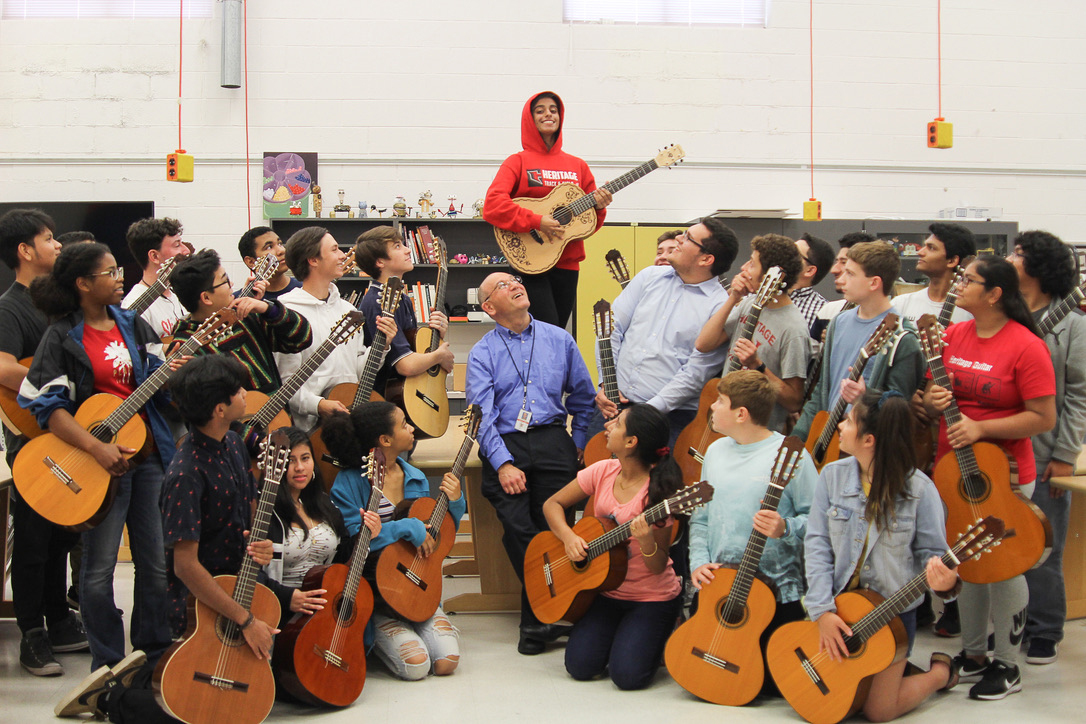
This example highlights my current freshman modern band class consisting of 2 drummers, 6 keyboard players, 2 basses (1 upright and 1 electric), 3 guitarists, 1 clarinet, 2 flutes, 1 trombone, and 2 cellists. At its most basic form, our modern band is divided into rhythm, strings, and wind sections. The class is a mix of mostly beginners and some intermediate students. This year, we have played “Oye Como Va,” “Uptown Funk,” “7 Nation Army,” “C Jam Blues,” “Blinding Lights,” and many more. My students even chose to create a modern band arrangement of “Fur Elise.”
As there are no arrangements for a group with such diverse instrumentation, we work together to determine individual parts, allowing us the ability to tailor the music to our needs so that all students are motivated and appropriately challenged. To do this, it becomes necessary to develop a common language around music so that we can communicate effectively. This helps to create “buy-in,” developing and growing an understanding of music notation (standard and iconic), music theory, and vocabulary which is centered around technique and critique. Rather than drilling note-reading, I am able to tap into their intrinsic desire to seek out greater understanding and to facilitate the ease with which they play. I also allow students to choose their preferred method of notation while introducing them to both forms. By the time they graduate, they are fluent readers in standard and iconic notation, have a deep understanding of theory (with an emphasis on line contour, chord structure, chord progressions, and song form), are adept composers and arrangers, have excellent aural comprehension, have proficient technical skills on their instrument(s), and can accurately critique musical performance using music-specific vocabulary.
Infusing Modern Band into Your Orchestra
Concepts, skills, and technique can be taught using any repertoire. Early in my career, “Viva la Vida” became one of the first pieces I arranged for my orchestra class (because at that time, I still felt that I had to be the arranger). As I gained confidence in my teaching, I was able to relinquish control little by little. We continued to grow our repertoire to include nearly every genre of music, while never abandoning classical music which challenged them in ways that kept them wanting to learn more. In 2010 we played the soundtrack to Black Swan because they were obsessed with that movie and a year later The Muppets came out and we wrote an arrangement of “Man or a Muppet.” Teaching modern band has allowed my orchestra students more ownership over their learning.

In the beginning, I like to teach comping patterns on open strings to songs like “Oye Como Va,” “Best Day of My Life,” “Can’t Stop the Feeling” and others. Utilizing backing tracks allows students to compose and lead short call and response patterns with their classmates. This gives the teacher time to circulate around the room to adjust technique as needed. Playing along with a recording builds good aural skills and improves tone. By using a chord-based approach along with comping patterns, students can easily play popular music in any key because they have more time to transition between different notes. Having them play along with backing tracks drastically improves intonation. In addition, it gives them an easy way to practice at home and while sounding like they are part of a band.
If we have learned anything from living through a global pandemic, it is to appreciate connecting with others, especially through music. Increasing the diversity of our ensembles allows for a richer sound and experience, enriching the lives of our students.
Catherine Plichta is the director of instrumental music at TAPCo in the Bronx