








 When faced with the freedom to write about whatever you want, it can be difficult to find the focus needed to write about anything; the blank page staring back at you, waiting to be filled with just right words. Of course, as a songwriter this is only the beginning. After penning the perfect words, you’ll still need to create a melody, add accompaniment, all while continuously editing these aspects of your work. It’s enough stress for even the most seasoned of songwriters. How, then, do we approach the task of songwriting in the classroom?
Working within set parameters can be a great way to start a songwriting project. Rather than tackling all of the various aspects of the songwriting process at once, try starting with just lyric writing. To give our lyrics some focus, let’s write a blues song. Now we’ve limited ourselves to writing about things that make us feel kind of sad or get us down. Once we’ve got a few lines about whatever’s got us feeling down, we can add those lyrics to an already existing melody and chord progression. Since we’ve written a blues song, the tried and true 12-bar blues progression is a great start. Or try my students’ personal favorite, singing their new lyrics along with the repetitive melodic lines and simple one chord progression to Muddy Waters’ “Mannish Boy.” When we are ready to take lyric writing to a more personal level, we can again find focus and inspiration in art that already exists. Look at a painting. How does it make you feel? What does it say to you? Even something as seemingly simple as a children’s picture book. What are the greater themes present in the story? How do they relate to you and your experiences?
We can even set limitation for ourselves when creating melodies. By using a chord progression that we already know, we can begin to sing a new melody. We don’t even need lyrics to do this. Just humming or using a neutral syllable can be a great start. We could then go back later and add lyrics. Or, try singing your lyrics with a single pitch. Then, when you’re comfortable, try singing two pitches. Maybe, you’ll feel really adventurous and go for three pitches. And if you’re thinking that’s not interesting enough for the melody of a song, just remember that the song “Sunflower” by Post Malone and Swae Lee plays around with three pitches for a large portion of the song’s melody. Some songwriters might find that their lyrics don’t need even need a melody. They may discover that the flow and phrasing is perfect without changing the pitch at all.
When it comes to creating that accompaniment for your masterpiece, again, create limits for yourself and your young songwriters. Play a simple two chord progression to start with. If your students are capable of extending this to three or four chords, fantastic. Even if your students aren’t instrumentalists, using DAWs like GarageBand or Soundtrap can open a world of possibilities (and a seemingly endless rabbit hole of samples and loops) to the young songwriter in terms of accompaniment choices.
Of course, great ideas are one thing, putting them into practice, another. Like any endeavor, whether it be songwriting, reading or multiplication, it’s essential to approach the material a small piece at a time and to also approach that material often. A child wouldn’t begin reading Dostoevsky before first learning their alphabet, or, take a step further back, before learning to speak the language through daily use and exposure. The same holds true for songwriting. Approach songwriting one small step at a time and approach it often. Songwriting is one way we can allow ourselves and our students to make musical decisions. Why not spend a few minutes allowing students to explore what it sounds like when they put some random chords into a progression? They will have created something new and will have had the opportunity to critique that creation through thoughtful self-assessment. Does the progression sound good? What could be changed to make it sound better? Throughout this short activity, the songwriter will have numerous opportunities to make their own musical decisions. Why not spend a few minutes having students hold a musical conversation with their friends to a simple drum beat? Not worrying about rhyming or phrasing or even making sense. They may find themselves more apt to take risks and try something new, all while taking part in musical decision making.
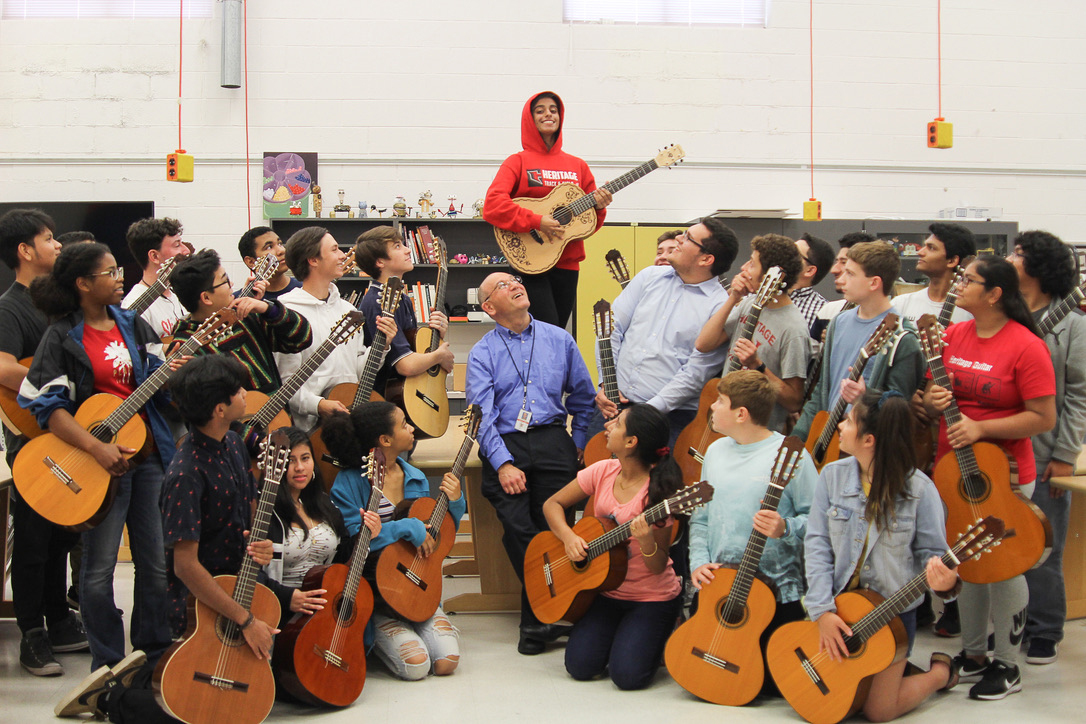
When it comes to songwriting in the music classroom, it can be, and often is, chaos. Controlled chaos, but chaos, nonetheless. It is important for the teacher to remember their role as producer when it comes to songwriting; to give the student a board to sound off to and to suggest possible courses of action for developing their songwriting abilities, and perhaps most importantly, to be the facilitator for their students learning. Allowing the space to experiment and grow as musicians, songwriters, and human beings.
Sean Moats is an elementary school music teacher at a public school in Tampa, Florida. He also runs professional development sessions on modern band and is a drummer.