






• Latest
  • Trending
Inclusive Teaching Strategies for the K–12 Guitar Classroom

Inclusive Teaching Strategies for the K–12 Guitar Classroom

February 18, 2026
What Makes a Truly Great Student Travel Experience

What Makes a Truly Great Student Travel Experience

February 17, 2026
Transformative Travel: How the Right Music Tour Partner Elevates Student Learning

Transformative Travel: How the Right Music Tour Partner Elevates Student Learning

February 17, 2026
UpClose-4

UpClose-4

February 14, 2026
Your Perfect Fit: How to Choose a Travel Provider

Your Perfect Fit: How to Choose a Travel Provider

February 17, 2026
Perspective

Perspective

February 12, 2026
Headlines

Headlines

February 12, 2026
Teachers’ Choice Winners at the NAMM Show

Teachers’ Choice Winners at the NAMM Show

February 7, 2026
Tone deaf – Decibel Scale

Tone deaf – Decibel Scale

January 29, 2026
Playing with Intent: The Missing Link Between Practice and Confidence

Playing with Intent: The Missing Link Between Practice and Confidence

January 27, 2026
French Versus German? The Over/Under on Double Bass Bow Holds

French Versus German? The Over/Under on Double Bass Bow Holds

January 26, 2026
New Products – January 2026

New Products – January 2026

January 23, 2026
Minute Clinic – STUDENT CONDUCTORS

Minute Clinic – STUDENT CONDUCTORS

January 23, 2026
Wednesday, February 18, 2026
  • Contact
SBO+
  • Advertise
  • Subscribe Free!
    • Manage Subscription
  • Departments
    • Choral
    • String Section
      • String Section
    • Concert Band
    • Modern Band
      • Mariachi
    • Orchestra
    • Instruments
      • Woodwinds
        • Wind Talkers
      • Percussion
        • GoodVibes
      • Repertoire
      • Playing Tips
    • Marching Band
    • Resources
      • Fundraising
    • Jazz
    • Brass
    • General Music
    • Advocacy
      • NAfME Neighborhood
      • MAC Corner
      • MusicEd: Mentor Minute
    • Commentary
      • Bubbett’s Bookshelf
      • Leadership Tips
      • Perspective
      • InService
        • America’s Bandmasters
        • America’s Musicians
      • Tone Deaf Comics
    • Features
    • News
      • Headlines
  • Current Issue
    • Past Issues
  • Support
  • Awards/Entries
    • 50 Teachers Who Make a Difference
    • Teachers’ Choice Awards
No Result
View All Result
  • Advertise
  • Subscribe Free!
    • Manage Subscription
  • Departments
    • Choral
    • String Section
      • String Section
    • Concert Band
    • Modern Band
      • Mariachi
    • Orchestra
    • Instruments
      • Woodwinds
        • Wind Talkers
      • Percussion
        • GoodVibes
      • Repertoire
      • Playing Tips
    • Marching Band
    • Resources
      • Fundraising
    • Jazz
    • Brass
    • General Music
    • Advocacy
      • NAfME Neighborhood
      • MAC Corner
      • MusicEd: Mentor Minute
    • Commentary
      • Bubbett’s Bookshelf
      • Leadership Tips
      • Perspective
      • InService
        • America’s Bandmasters
        • America’s Musicians
      • Tone Deaf Comics
    • Features
    • News
      • Headlines
  • Current Issue
    • Past Issues
  • Support
  • Awards/Entries
    • 50 Teachers Who Make a Difference
    • Teachers’ Choice Awards
No Result
View All Result
SBO+
No Result
View All Result

Inclusive Teaching Strategies for the K–12 Guitar Classroom

February 18, 2026
in Uncategorized
0
Inclusive Teaching Strategies for the K–12 Guitar Classroom
Share on Facebook
ADVERTISEMENT

The following article sample was reprinted from American String Teacher, vol 74, issue 4 with permission from ASTA and the author. 

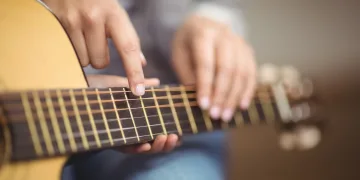
Occasionally, a new student will enter our classrooms and present us with a new pedagogical challenge. While you may initially think you are not equipped to support the student, upon reflection you may just find a key to that student’s success. More times than not, the solutions and strategies to meet these challenges will benefit not only the new student, but their classmates as well. Here are some teaching strategies for helping the hearing impaired, the visually impaired, and students who may struggle with reading musical notation become successful musicians in the K–12 classroom. 

Assisting the Hearing Impaired 

ADVERTISEMENT

Two weeks before the school year started, I was told a deaf student would be in my class. I was not sure how I would teach this student, so I watched a documentary about Evelyn Glennie (2005) called, Touch the Sound. Glennie is a professional percussionist who is deaf. The documentary was fascinating, but it did not directly lead to the specificity needed to play guitar. 

Further reflection led to a practical solution, “touch the sensation.” If the student could feel the vibration underneath his left-hand fingertip, he would know that he plucked the correct string. If he did not feel the vibration under his fingertip, he did not pluck the correct string. To know if he played the correct open string, he could simply watch the string vibrate. 

ADVERTISEMENT

Assisting the Visually Impaired 

Proprioception is the ability to know where your extremities are in space whether or not you are moving. This is quite useful when playing your instrument. Try this exercise yourself and with students: 

Step 1: With your guitar in position, drop your left arm so it is down and at your side. 

Step 2: Swing your arm from the elbow into a playing position without aiming. 

ADVERTISEMENT

Where did your hand land? For me, my hand consistently lands in 7th position. With this information, I am able to reference the fingerboard without looking at it. If I want to be in fifth position, I swing my arm and feel slight tension as I move my arm to the left. If I want to be in first position, I simply open my armpit. Ninth position is very easy to find by using fine touch. I simply let the side of my fourth finger touch the body of the guitar. Several years ago, a blind student played for me in a master class. I was fascinated by her ability to play along the entire fingerboard with shifts from one position to another. She was a master at proprioception and indiscriminative touch. She learned music from braille music notation and had to memorize it. Using proprioception and indiscriminative touch in this way can help all students with increased facility and shifting on the instrument. 

Assisting Students Who Struggle with Musical Notation 

Reading music is a learned ability. Many students have difficulty learning this skill. The lines and spaces are often taught with acronyms like Every Good Boy Does Fine for the lines and F-A-C-E for the spaces. While these may be useful at the onset, many students continue to use these years later rather than knowing the notes. In this system, students are scanning from bottom to top for every note. 

The sense of vision can be more efficiently applied. Humans look for focal points in the visual field. Edges outline these focal points. The bottom and top lines can be considered edges. The bottom and top lines are alphabetical. In treble clef, the notes are “E” and “F.” The middle line is also a focal point as it is in the center of the edges. The middle line is “B” in treble clef. I teach my students to remember that “B” is between everything. With the bottom, top, and middle lines as focal references, it is easy to apply the alphabet forward and backward. 

When I teach the staff, I ask a student who has never read music before to stand at my white board. I point to the notes on the bottom, top, and middle lines and have them tell me the note names. I continue by pointing to notes just below or above the three points of reference then increasingly point more randomly. Most students can identify the notes on the staff within 5 minutes. This may be a much more efficient approach to learning notes on the staff. 

View the pictorial samples and read more by accessing the full article at www.astastrings.org.   


You may also like:

Technology: Music Ed Apps The 22nd Annual 50 Directors Who Make a Difference SBO Presents The 19th Annual 50 Directors Who Make A Difference SBO Presents the 21st Annual 50 Directors Who Make a Difference SBO Presents the 20th Annual 50 Directors Who Make a Difference
ADVERTISEMENT
Previous Post

What Makes a Truly Great Student Travel Experience

ADVERTISEMENT
  • February 2026

    Articles | Digital Issue
  • January 2026

    Articles | Digital Issue
  • December 2025

    Articles | Digital Issue
  • November 2025

    Articles | Digital Issue
  • October 2025

    Articles | Digital Issue
© 2005 - 2026 artistpro, LLC
7012 City Center Way, Suite 207
Fairview, Tennessee 37062
(800) 682-8114

No Result
View All Result
  • Advertise
  • Subscribe Free!
    • Manage Subscription
  • Departments
    • Choral
    • String Section
      • String Section
    • Concert Band
    • Modern Band
      • Mariachi
    • Orchestra
    • Instruments
      • Woodwinds
      • Percussion
      • Repertoire
      • Playing Tips
    • Marching Band
    • Resources
      • Fundraising
    • Jazz
    • Brass
    • General Music
    • Advocacy
      • NAfME Neighborhood
      • MAC Corner
      • MusicEd: Mentor Minute
    • Commentary
      • Bubbett’s Bookshelf
      • Leadership Tips
      • Perspective
      • InService
      • Tone Deaf Comics
    • Features
    • News
      • Headlines
  • Current Issue
    • Past Issues
  • Support
  • Awards/Entries
    • 50 Teachers Who Make a Difference
    • Teachers’ Choice Awards

© 2005 - 2024 artistpro, LLC 7012 City Center Way, Suite 207 Fairview, Tennessee 37062 (800) 682-8114

Wenger Transcend Ad
Wenger Transcend Ad