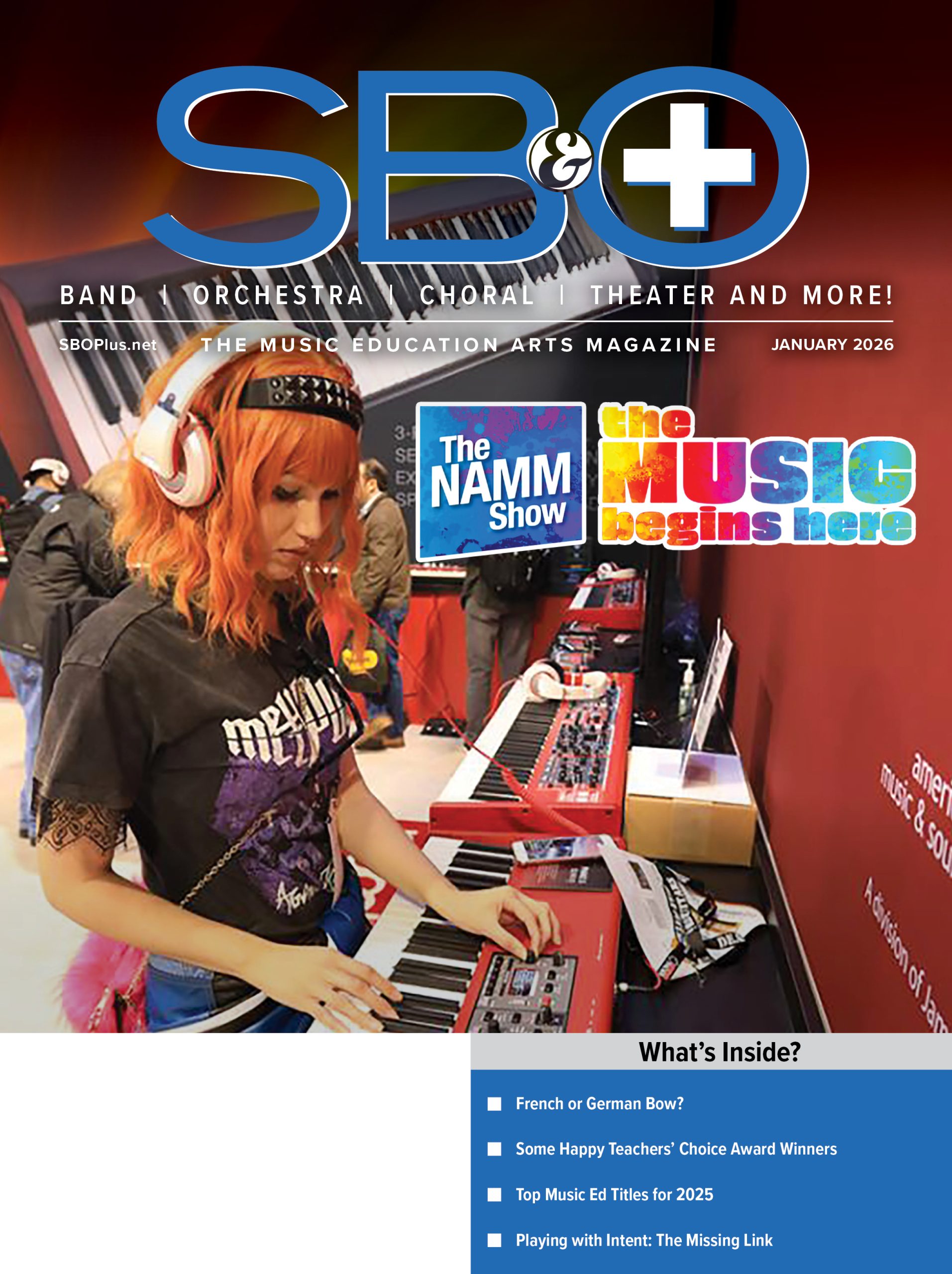




The NAMM Show in January is where manufacturers roll out their new products. Each year, SBO+ dispatches our undercover team to find the “Best Tools for Schools.” This year is one of our best selections ever.
Best Technology & General Music Tool
Making Beats (MusicEDU × Roland)
If you’ve ever watched a general music class mentally check out during a rhythm unit, Making Beats may be the reset you’ve been looking for. This four-part electronic music production course—developed in partnership with Roland—puts students in the role of music-makers from day one. No prior instrumental experience required. No long runway before something meaningful happens.
Students build real beats immediately, which means every kid in the room participates. The interface is intuitive enough for students and for teachers who would not describe themselves as tech-confident. The pricing is realistic for building a classroom set, and the curriculum aligns with national standards—always a relief when admin starts asking questions.
Whether you’re offering extensions and reinforcement learning in an ensemble program or running standalone general music, Making Beats delivers relevance without sacrificing musical substance. It sneaks in theory, structure, and listening skills under the hood—and that’s exactly the kind of tool most of us are searching for.
Best Step-Up Series
Eastman K Series Brass (S.E. Shires & Willson)
Let’s be honest: too many “intermediate” instruments are just beginner horns with nicer lacquer and higher expectations. The Eastman K Series takes a different approach, combining professional design principles the Eastman brands are revered for with a school-appropriate price point.
Spanning S.E. Shires trumpets, cornets, flugelhorns, French horns, and trombones, along with the Willson euphonium, this line gives advancing students access to features that actually matter: Monel pistons, Rotax rotary valves, open-wrap F-attachments, and compensating systems on the euphoniums. These aren’t buzzwords; they’re the difference between students fighting their equipment and learning how to shape sound.
For programs with players outgrowing their beginner instruments—but not ready or funded for full professional models—this series fills a long-standing gap with integrity.
Best Program Builder
Leblanc Bassoon in C (LBN511S)
Bassoon programs often stall for one simple reason: there hasn’t been a reliable, school-friendly instrument that truly supports advanced study. The Leblanc LBN511S addresses that gap in a beautiful, student-centered design.
Built from Alpine maple and featuring a full Heckel system—including left-hand whisper key lock, high D/E♭/E keys, and right-hand thumb rollers—this instrument offers the same functional layout students will encounter on professional models. Two bocals are included, and every bassoon is professionally set up, play-tested, and adjusted at Conn-Selmer’s Elkhart facility before shipping.
For programs committed to supporting serious bassoonists through high school and into collegiate-level repertoire, the LBN511S provides durability, consistency, and tonal depth without putting strain on already-tight budgets.
Best Podium Essential
Mollard Lancio Baton
Most conductors don’t think about fatigue—until their wrist tells them to. The Lancio Baton from Mollard quietly solves a problem many of us have normalized.
By concentrating mass in the anodized aluminum handle rather than the shaft, the Lancio reduces strain during long rehearsals and performance days. The pearlescent white carbon-fiber shaft is durable enough to withstand real-world use, including when paired with a stand to produce a conductor-powered ‘metronome’ effect, and the handle accommodates a range of grip styles. Available in 12″, 14″, and 16″ lengths with multiple handle colors, this is a baton you’ll reach for year after year.
Best Band Innovation
Sound Innovations, 2nd Edition – Spanish Translation (Alfred Music)
Directors serving bilingual and ESL students have spent decades improvising, but not in the way you’d expect in a music classroom: translating instructions on the fly, creating extra materials, or hoping students could keep pace. Sound Innovations, 2nd Edition changes that.
Alfred’s fully translated Spanish edition of Book 1 (concert band and string orchestra) is the first major method series to offer this level of accessibility. It’s fully compatible with the English edition, allowing mixed classrooms to rehearse together, supported by free downloadable PDFs that bridge any content differences. Combined with updated repertoire and integration with MakeMusic Cloud’s Center Stage feature, this edition meets students where they are—and removes barriers that never needed to exist in the first place.
Best Beginning Band Tool
Yamaha Flute Assist Attachment (ASTFL)
Every director knows the early-flute struggle: weeks of air with no sound, stalled progress, and frustrated students. The Yamaha Flute Assist offers a practical solution.
By guiding airflow to produce a stable tone with a simple breath, the attachment allows students to practice fingerings and reading while embouchure develops independently. It fits securely on the headjoint, includes protective patches, and comes with a compact case and online guide. Developed through extensive research and endorsed by professional flutists, the ASTFL gives beginners an early win—and directors one less section to triage.
Best Marching Band Tools
Yamaha Power-Lite Series Drums (MQ-6300)
Weight is the enemy of young marching percussionists—and the directors responsible for them. Yamaha’s Power-Lite Series solves this with an ultra-light design that doesn’t compromise sound.
Using Yamaha’s MTP (Maximum Tonal Projection) shell cut and borrowing specifications from their professional Field-Corps line, these multi-toms project clearly while remaining accessible for middle-school and younger high-school players. They’re also built to survive real program life: buses, storage rooms, pep band season, and everything in between.
Gripophone Lyre Attachment
Designed by a trumpet player who’s also an engineer. He got tired of carrying around those crappy sheet music lyres that scratch the lead pipe, rotate if too loose, strip the screw if too tight, start flopping around my old sheet music in the wind, etc. Hence, he designed the Gripophone. There’s a model for every instrument in the marching band. Ideal for use with Beam Music or other apps that distribute music to student cell phones.
Best Accessory
Hercules DS753BB 2-Way Low Brass Stand
Low-brass players have long needed a stand that works both seated and standing. The Hercules DS753BB finally delivers.
Supporting tubas, euphoniums, and baritones up to 22 pounds, the stand adjusts from 15.75″ to 47.24″ using a secure Power Lock lever. Detachable tubing accommodates different instruments, the removable pad allows freedom of movement, and a carry bag makes it practical for daily program use.
Best Wind Ensemble Tool
Majestic Concert Black 2.6-Octave Symphonic Bells (B626S)
At the wind-ensemble level, bells are not an accessory—they’re a defining voice. The Majestic B626S delivers with high-carbon steel bars that produce a brilliant, focused sound capable of cutting through full ensemble textures.
The extended 2.6-octave range (F5–D8) expands repertoire options, while optimized nodal points and a curved mounting rail allow the bars to resonate freely. The heavy-duty wood case enhances projection and durability, and the included Chris Lamb CL-G3 mallets mean students are performance-ready immediately.
Best Choral Ensemble Resource
The TB Collection (Alfred Music)
The changing male voice remains one of choral music’s greatest retention challenges—largely because we ask students to sing music that wasn’t written for them. The TB Collection addresses that directly.
These nine carefully curated pieces respect range, tessitura, and text choices that resonate with emerging tenors and baritones. The reproducible format avoids investing in stacks of octavos students will outgrow, while accompaniment tracks and vocal demos provide accurate learning models. For directors serious about keeping young men engaged through vocal transition, this resource belongs on the shelf.
Best Overall Must-Have Tool for All Ensembles
MakeMusic Sight Reading Studio
Sight reading matters. We all know that. The challenge has always been volume and variety—finding enough quality material without spending hours hunting.
Sight Reading Studio eliminates that problem entirely. The platform generates unlimited, customizable exercises on demand. You can save favorite rhythm patterns, pull tricky passages from current repertoire, or display full-ensemble exercises in Ensemble Mode. Students practicing at home receive real-time feedback on pitch, rhythm, and tempo—meaning they’re actually learning, not guessing.
Band, orchestra, choir, jazz, beginner or advanced—this tool works across the board. And yes, your festival sight-reading scores may start creeping up.
Best New Music Technology/Composition Tool – Audio Mover LISTENTO
Software DAW’s, such as Ableton Live, Pro Tools, and Logic Pro, continue to be widely used by students and professionals for their advanced audio and MIDI features. Unfortunately, they still lack the collaborative features of their web-based cousins (e.g Soundtrap, Bandlab) – until now! Thanks to Audio Mover’s new plugin LISTENTO, teachers can transform any software DAW into a collaborative space for music making. LISTENTO, a realtime audio streaming tool, can share high quality sound from the DAW to anyone, anywhere. Students access a sharable link to listen live in a web-browser or app. As they record, edit, mix, and master all in real-time from different locations, the feedback process seamlessly blends with in-the-moment performance decisions. No more exporting or waiting for files! LISTENTO also supports timecode and video synchronization, making it useful for film scoring, multimedia, and audio-for-video projects. There’s no doubt, LISTENTO is the next big thing for the industry and a game-changing tool for young musicians.
Best Secondary Accessibility Tool – DigiCo Mixing Console
DigiCo is a UK-based manufacturer of professional live mixing consoles and stage input solutions used worldwide. In addition to outstanding sound quality and hardware design, DigiCo has developed an exceptional accessibility program that provides spoken feedback for all major console controls from volume to mute, EQ, etc. This allows blind and visually impaired students to independently learn and operate professional mixing equipment—an amazing opportunity for young audio engineers. By making this accessibility solution open source and available to other manufacturers, DigiCo is actively advancing inclusive design across the entire audio industry. Combined with the professionalism, talent, and genuine kindness of the DigiCo team, this commitment makes their products an outstanding choice for schools seeking to support students interested in music technology and audio engineering.
Best Elementary Accessibility Tool – Arcana Strum
Founded in 2015, after a young musician shared her struggle to feel equal and included, the company, Arcana Instruments, brought together musicians, engineers, and designers to address accessibility in music-making. This instrument is the product of their beautiful collaboration. The Arcana Strum is an inclusive, highly customizable musical instrument for students of varying abilities. It can be configured to play chords, scales, or single notes with minimal physical movement, making it especially accessible for students with motor or cognitive challenges. Its flexible control options allow educators to tailor the setup to each student’s physical needs, musical goals, and skill level. With students focusing on musical expression rather than complex technique, the Arcana Strum helps build confidence and creativity in their music making. This adaptability makes it an excellent tool for ensembles, general music, and music therapy classrooms.
Non-Traditional Music Ensemble Tool – Roland Cube Street Mini P.A.
Starting a non-traditional ensemble requires some new gear, a lot of which can be too expensive or not fit for a small classroom space. The Roland Cube Street Mini, a compact amplification system, is a great versatile option for your electric instruments. Less than 5 pounds each, these tiny amps produce a clean and quality sound for in-class practice, solo practice, small group rehearsals, and performances. On the back are two instrument channels with on-board effects. The main channel is equipped with a ¼ jack for guitar, vocals, or stereo instruments (keyboards), and the second channel hosts a TRS combo instrument jack for a microphone. The Cube Mini also includes a built-in instrument tuner, stand with mic stand mount, up to 7 hours of rechargeable battery life, and Bluetooth connectivity for accompaniment playback. At a great price, this amplifier is a great choice for your beginning small ensemble or non-traditional music class.
Our “Best Tools” Team
Gillian Desmaris
Dr. Elisa Janson Jones
Tom Palmatier