A mnemonic can help a student recall the bass-clef lines. It can also become a five-word detour before every note. Keep it available, then build a faster route through landmarks, steps, and short patterns.
From the bottom upward, bass-clef lines are G-B-D-F-A and the spaces are A-C-E-G. A familiar line mnemonic is "Good Boys Do Fine Always"; students can invent another if it helps. The bass-clef sign identifies F on the fourth line, between its two dots. That F is a useful starting point for reading nearby notes.
Establish two anchors
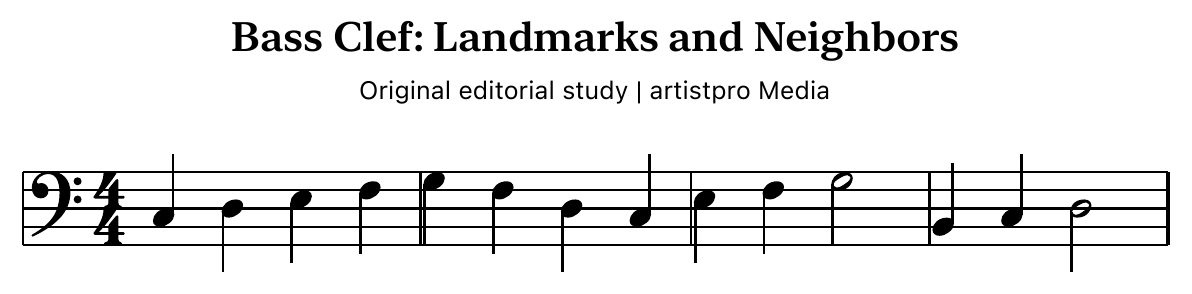
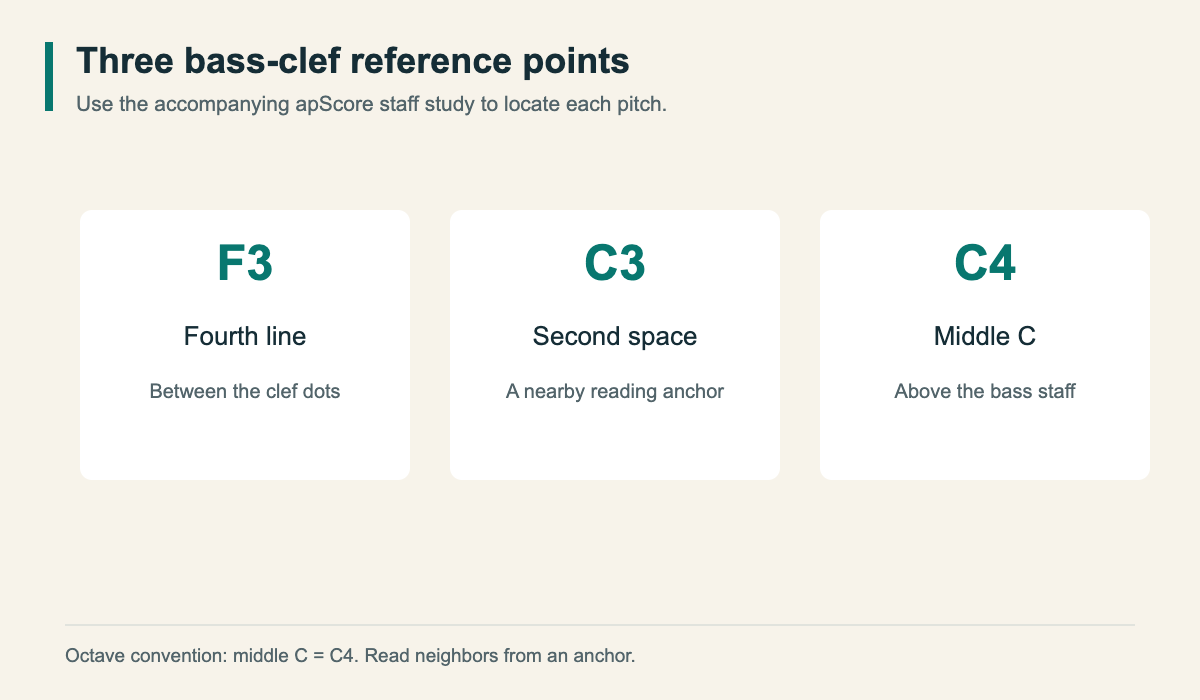
Show the F between the dots and the C in the second space from the bottom. On the accompanying score, those are F3 and C3, while middle C, C4, lies above the staff. Ask students to locate each anchor without counting through all the lines.
For an instrument class, immediately connect the written note to a comfortable fingering or position. For a listening task, explain any octave convention used by the instrument before judging the response.
Use the same octave-labeling convention across the handout and any keyboard display. In this resource, middle C is C4.
Read the distance from the anchor
Place E3, F3, and G3 around the F landmark. Students point to the anchor first, then identify a step below or above it. Play the three pitches as a short phrase. Reverse the order and ask whether the shape on the staff predicts the direction they hear.
Repeat around C3 with B2-C3-D3. Limit the notes long enough that students can stop treating every symbol as an isolated identification problem.
If a student continually reads in the wrong direction, draw a short rising path through alternating lines and spaces. Let the student trace it while naming the next letter. The aim is to connect upward movement on the staff with ascending letter names, while accounting for the repeating seven-letter cycle.
Group notes into a phrase
Use the two-measure reading phrase on the score: C3-D3-E3-F3, then G3-F3-D3-C3. Before anyone plays, ask students to describe its shape. It moves up by steps, then returns through a descending pattern with a skip.
Have them point to the opening and closing C. Next, identify the highest note. Only then perform the phrase. Students now have a route through the music rather than eight separate questions to solve at tempo.
Transpose the rhythm to a comfortable register if the written range does not suit the instrument or learner. Preserve the staff-reading objective and label the change clearly.
Check reading separately from technique
A student may identify and sing a phrase correctly but stumble on an instrument. Ask for a pointing, spoken, sung, or keyboard response before deciding that notation is the problem. Conversely, a memorized fingering pattern can conceal uncertain reading. Change the order of familiar notes and ask for a fresh response.
Avoid covering a whole page in letter names. Annotate the landmarks the learner needs, then gradually reduce that support. Leave room for students to mark their own starting points.
Finish with an unfamiliar neighbor
Show one new note next to a known landmark. Ask the student to name it, explain its position, and include it in a two- or three-note phrase. That explanation shows whether the landmark has become useful beyond the exercise.