
Ask a child to make the last sound of a phrase softer, and you have opened a conversation about dynamics. Ask why the phrase sounds finished, and you have opened another about form or tonal arrival. Music theory gives those observations useful names. It need not begin as a separate vocabulary lesson.
Plan a sequence around a small musical task. Each lesson should let students hear an example, respond in an accessible way, make a decision, and show what they understand. The sequence below is a starting plan; advance when the class can use the idea, rather than when the calendar says the topic is finished.
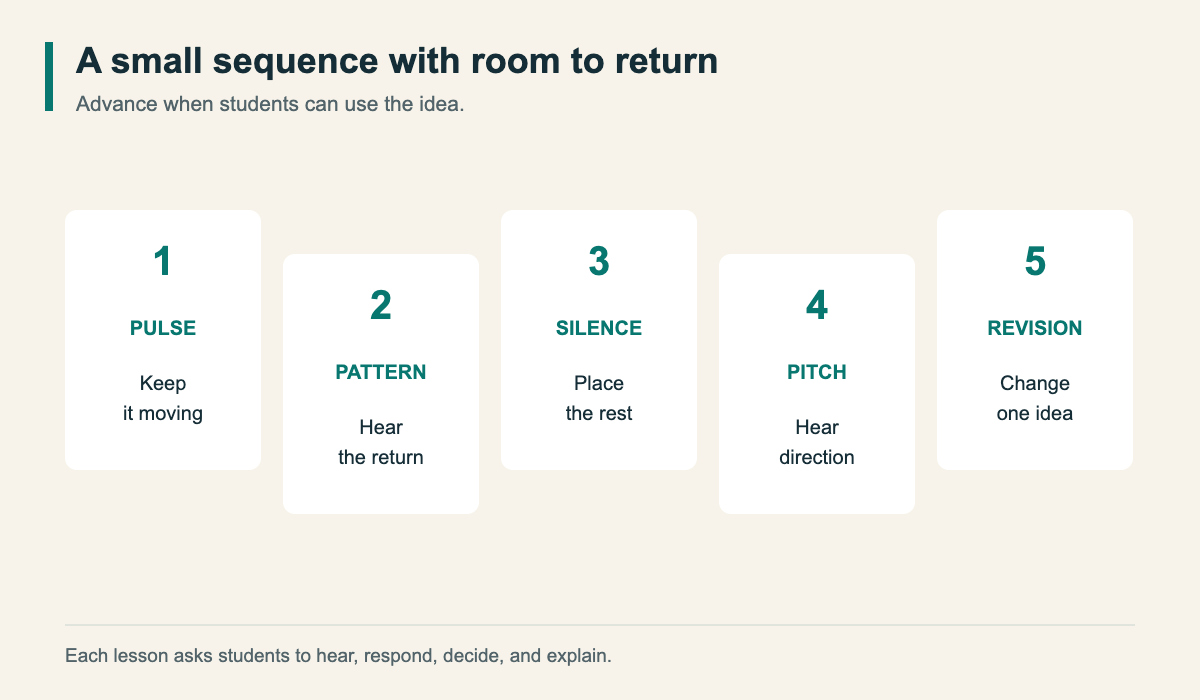
Begin with a dependable pulse
Perform a short chant or a repeated instrumental pattern. Ask students to show the steady beat while you vary the rhythm. Use steps, taps, a small hand movement, or another response that suits the learner.
Then exchange jobs. Students create a short rhythm while you keep the beat. Ask whether the beat changed when the surface pattern changed. Keep the first patterns familiar enough that children can listen while performing.
A useful check is one child maintaining the pulse while a partner changes the rhythm. A page of correctly named notes would not show the same understanding.
Let patterns return
Create a four-beat rhythm and repeat it. Follow with a contrasting four-beat rhythm. Students can call the patterns A and B after they can recognize the difference by ear.
Build A-A-B-A. Ask a small group to perform it from four large letter cards. Then change the card order and have the class predict what will happen before playing. Keep the rhythm assigned to each letter unchanged for this task, so the class can hear form rather than a series of unrelated events.
Give silence a location
Replace one attack in pattern A with a rest. The beat continues. Have children point to the place where the sound is missing, then recreate the revised pattern. Introduce the appropriate symbol once they can hear and perform its job.
Use "Teach the Rest Before You Count It" for notation and a short assessment. Do not introduce every note and rest value in the same lesson. Add enough notation to preserve the music the class is making.
Organize pitch within a reachable range
Sing or play three pitches that fit the class comfortably. Make a two- or three-note pattern, then let students identify whether the next version repeats, steps, or changes direction. Offer a pointing response or a sequence of large visual cards when singing is not the right response method.
For pitched instruments, confirm that the chosen notes are available and manageable. A child should not fail a pitch-comparison task because the instrument is difficult to hold or the part demands an unfamiliar technique.
Make a piece small enough to revise
Ask pairs to create two four-beat measures using the rhythm vocabulary they have already performed. Add a limited pitch set only if that is a separate, achievable next step. Students preserve the pattern using notation, an agreed visual representation, or a teacher-assisted record.
One partner performs; the other checks it against the record. Each pair changes one thing and explains the musical effect. "We put the rest before the last sound so the ending stood out" is evidence of a decision. A polished result alone cannot explain who understood it.
Keep the evidence specific
Use the same three questions across the sequence: What did the student do independently? What support was needed? What will the next task reveal? Short answers are enough.
The class can revisit pulse, pattern, silence, and pitch throughout the year. Each return should ask students to do something more with the music they already know.