A minor key needs more explanation than "it sounds sad." Tempo, register, rhythm, harmony, and performance all affect character. Give students something more precise to hear: the tonic, the third above it, and the way a phrase approaches its ending.
Begin with A minor. Its natural-minor collection is A-B-C-D-E-F-G-A. The third above A is C, a minor third. Compare that with A major, where the third is C-sharp. Keep the opening rhythm and the tonic the same so students can attend to the changed interval.
Find the arrival before naming the scale
Play or sing a short phrase that settles on A. Repeat it and stop one note before the ending. Ask students to sing or play the note they expect next. Then complete the phrase.
Ask what made A feel like an arrival. Students may refer to repetition, the bass, the last note, or the harmony. Test those explanations by changing one element. A single ending note is evidence to consider, not automatic proof of a key.
Next, play a C-major phrase using the same key signature. C major and A minor share a signature but organize their music around different tonics. The absence of sharps and flats does not settle which one is operating.
Compare G with G-sharp in context
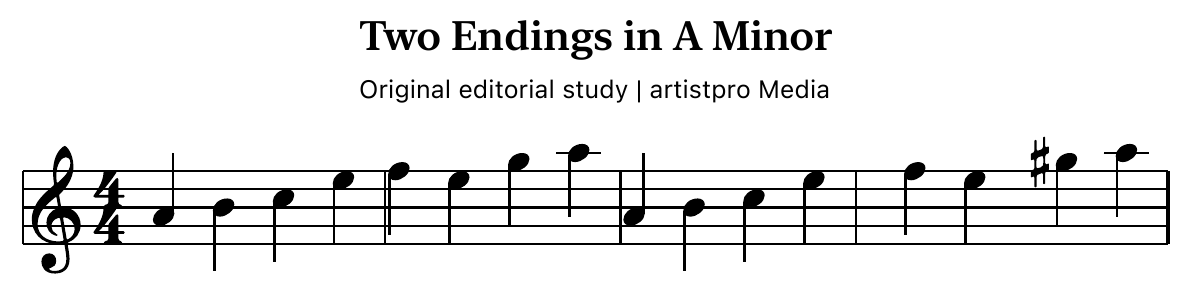
The accompanying concert-pitch apScore study presents two A-minor phrases. Both begin A-B-C-E and end on A. In the first ending, F-E-G-A, the G-natural approaches the tonic by a whole step. In the second, F-E-G-sharp-A, the approach is a half step.
Perform the phrases at the same tempo and with the same articulation. Ask students to describe the difference at the ending before supplying the term "leading tone." Then identify the G-sharp as the raised seventh scale degree in A minor.
Students do not need to agree that one version is better. They should hear and explain the particular change. The second phrase demonstrates a common leading-tone treatment, not a rule that every minor melody must use G-sharp.
Put the three common forms beside one another
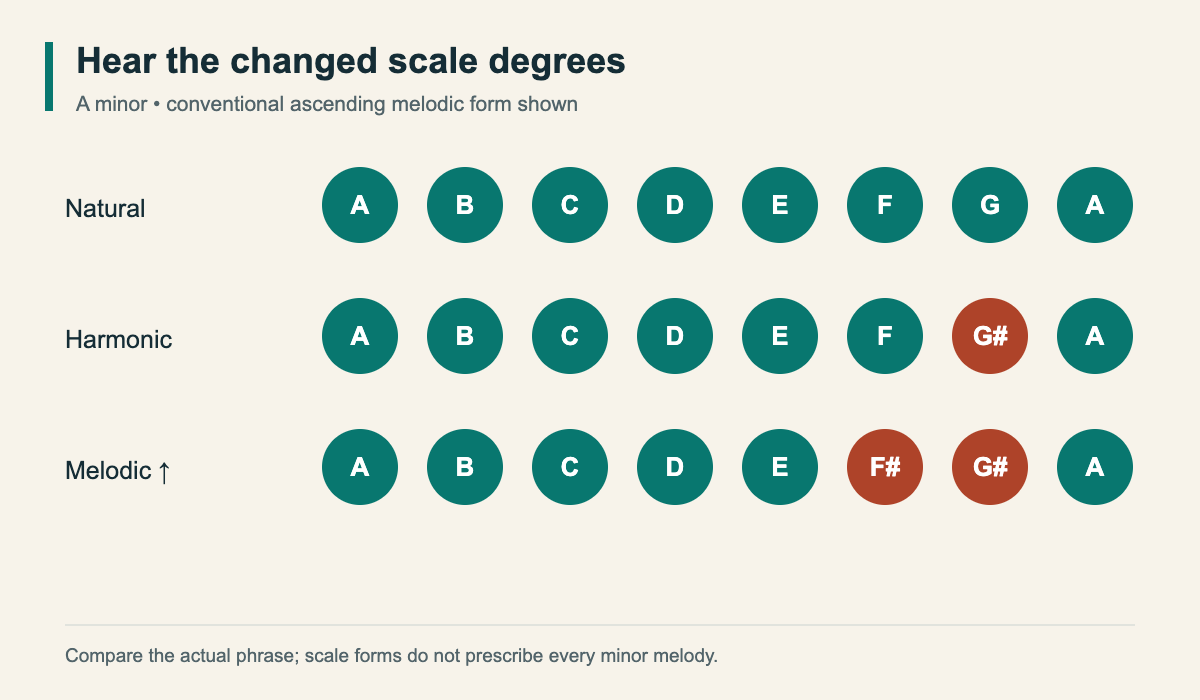
Natural minor supplies the unaltered collection. Harmonic minor raises scale degree seven. In the conventional ascending melodic-minor form, six and seven are raised; the conventional descending form returns to natural minor. Jazz musicians commonly use the raised-sixth-and-seventh collection in both directions.
In A, the ascending melodic form therefore includes F-sharp and G-sharp. Explain which convention the exercise uses rather than marking a student wrong for recognizing another established usage. In actual music, inspect the notes and their function instead of expecting every phrase to behave like an uninterrupted scale exercise.
Let students choose an ending
Ask each student or pair to write a two-measure phrase in A minor using four quarter-note beats per measure. Require an ending on A and an explanation of the note immediately before it. They may choose G-natural, G-sharp, or another approach that they can hear and defend.
Preserve both the first draft and one revision. Have a partner perform the notation before the composer describes the intended sound. If the performance and intention disagree, locate the discrepancy together.
Assess the musical explanation
Look for a named tonic, correct notation of the chosen pitches, and a description connected to the actual ending. Do not award understanding merely because a student calls the result sad or dramatic.
The useful question is smaller and more exact: What changed, where did it change, and what did that change do to this phrase?