













Selecting repertoire for your jazz groups is (of course) every bit as important as choosing material for your other concert ensembles. Chances are that you and your students will be spending a lot of time and energy on the music you select, so not only should it be high quality, but it needs to be literature that will challenge your group without overwhelming them.
One of the things I stress when talking with directors is that a grade 2 Jazz selection is quite different from a grade 2 Concert Band piece. In my opinion, a grade 2 Jazz piece will probably be considerably more difficult than a “concert” selection at the same level. There are several things that account for this:
Swing feel
Instrumentation
Ensemble scoring
Harmonic language
Rhythm section
Improvisation
So, even though a grade 2 Jazz chart might use the same basic range guidelines for each instrument as a comparable work for Concert Band, there are many other elements that need to be considered when reviewing jazz literature for your ensemble. Let’s look at them.
- Swing feel
Volumes have been written about this but suffice it to say that the whole concept of “swing” is central to Jazz, so it is important for us to impart this essential element of the music to students at the beginning of their jazz journey. When reviewing a piece that is aimed at the grades 1 – 2 level in the swing style, the main components to look for in the wind parts (more on the rhythm section later) are the use of common swing figures and consistency of rhythmic presentation. If there is a tricky rhythm, check to make sure it is notated the same way each time it occurs and beware of multiple variations on the same rhythmic pattern.
- Instrumentation
It is difficult at the younger levels (grades 1 & 2) to be able to count on strong players for the full instrumentation of a jazz ensemble, so the first “requirement” at this level is that the music should sound full and complete with less than the typical 5 Saxes, 8 Brass and 4 Rhythm section players. The core instrumentation that publishers often use is 2 Altos, 1 Tenor, 2 Trumpets, 1 Trombone, Piano Bass, and Drum Set. There are also often parts in the set for a full band, but they are not required for the piece to work. Something else to look for are additional optional parts for Flute, Clarinet, Horn and Tuba since at the easier levels there are often lots of students who would like to participate, but don’t play “traditional” Jazz instruments.
In grades 3 & 4 material, look for standard instrumentation for jazz ensemble, often with additional optional parts for vibes, auxiliary percussion instruments or featured solo instruments.
- Ensemble scoring
As you might expect, in grades 1 & 2 publishers rely on unison melodic lines and tutti rhythmic figures to help make the music playable by less experienced musicians. As with any concert work, it is important that there is some contrast in the rhythmic and melodic presentation of the music, and while it is common at the easier levels to have everyone playing most of the time, there should still be color changes and variety in timbre and dynamics.
In grade 3 & 4 charts, there is more independence in and between each section along with a variety of instrument combinations to make the music more interesting and challenging for the players. For example, instead of Saxes playing the head in unison, a trio of Alto 1, Trumpet 2 and Guitar might carry the main melody with just Piano and Bass accompaniment. There will often be more interweaving lines between sections and less use of tutti rhythms and “block” ensemble scoring.
- Harmonic Language
Students today are sophisticated enough to recognize when music sounds bland or “square” so the harmonic vocabulary of music at these easier levels needs to find a good balance between vanilla sounding major, minor and dominant chords and more advanced chord structures including the upper extensions like the 9th, 11th and 13th. As a result, even music at grades 1 – 2 will be more chromatic than a concert band piece at this level. This makes voicing of chords and voice leading within parts even more crucial.
- Rhythm Section
Over the years, I have seen many fine works for jazz ensemble get derailed by poorly written rhythm section parts. It is common to see a piece that has perfectly acceptable parts for the Saxes and Brass – reasonable ranges and rhythms, thoughtful harmonic structure, well-marked articulations – but sketchy rhythm section parts that lead to a disastrous first rehearsal. Here are some of the key elements to look for in grades 1 – 2 rhythm section parts:
Guitar – there should be clear and concise chord symbols and/or single line melodies that double a wind part. Avoid any Guitar parts where there are multiple notes written out for each chord voicing. Sometimes writers double the Piano voicings in the Guitar and they are often unplayable on the instrument and are too difficult for a young Jazz Guitar player.
Piano – these parts often come in two extremes. The first is a completely overwritten part where the Piano is doubling all the notes in a chord that the Saxes and Brass are playing. These kinds of parts are difficult to play and will never be heard over the band.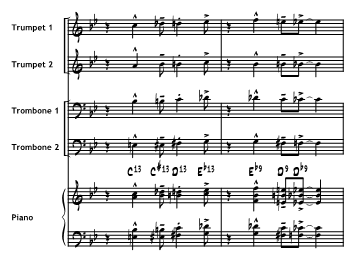
The other extreme is just a chords and slashes sketch. Clearly, this approach would be out of reach for a young Piano player.
On easier charts, look for Piano parts that have suggested 3 or 4 note voicings written out with sample “comping” rhythms. The Piano parts should include chord symbols to help the student make the transition to more difficult music. When reviewing an upper-level piece, it is vitally important that the chord symbols in the Guitar and Piano parts accurately reflect what is happening in the rest of the ensemble, so spend some time picking apart chords. Obviously C7 is not the same as C+7(#9), and if the composer is not specific enough with chord symbols in the Guitar and Piano parts, it will lead to lots of harmonic clashes between the rhythm section and the winds and waste valuable rehearsal time.
 Bass – Many times in a rock or funk composition the Bass might have a repetitive 2 or 4 bar lick that forms the foundation of the piece. As with wind parts, it is important that the rhythm be presented consistently. On a young swing chart with a walking bass line, it is preferable to have both the notes and chord symbols notated. While the chord symbols need to match precisely between the Piano and Guitar, on the Bass part at this level it is fine if the chords are simplified a bit. For example, using G7 instead of G13(#11) will make more sense to a young Bass player.
Drum Set – This is the wild west! Like a Piano part, there are two extremes that are often seen in a Drum part: overwritten or underwritten. Over the years, I have talked with many professional and student drummers about what they like to see in a part and the consensus is that if a composer wants a particular groove played it is best to write out a 2 or 4 measure pattern to get the player headed in the right direction. After that, it is OK to use slashes with the rhythmic hits in the ensemble notated at the top of the staff.
- Improvisation
Improvisation is at the heart of Jazz and ideally, every student should be given the opportunity to play an improvised solo at some point even if it is not in a concert setting. I’m not suggesting that all the players should sound like pros, but even beginning players can improvise if they are given some parameters. When selecting an easier chart, look at the solo sections to see if the chord progression is manageable and that the solo isn’t too long. It is also helpful if there are some background figures included in the horn parts, so the soloist is not stranded with a young rhythm section. As the grade level goes up, the solo sections should become longer and more involved.
Conclusion
Selecting repertoire for jazz groups is crucial as it impacts the time and energy invested by you and your ensemble. It is important to note that each publisher, retailer and state organization has its own criteria for grading music, so zeroing in on the six broad categories mentioned above will help you determine what will be best suited for your group.
Peter Blair is the Jazz Editor at Excelcia Music Publishing & Kendor Music Publishing.