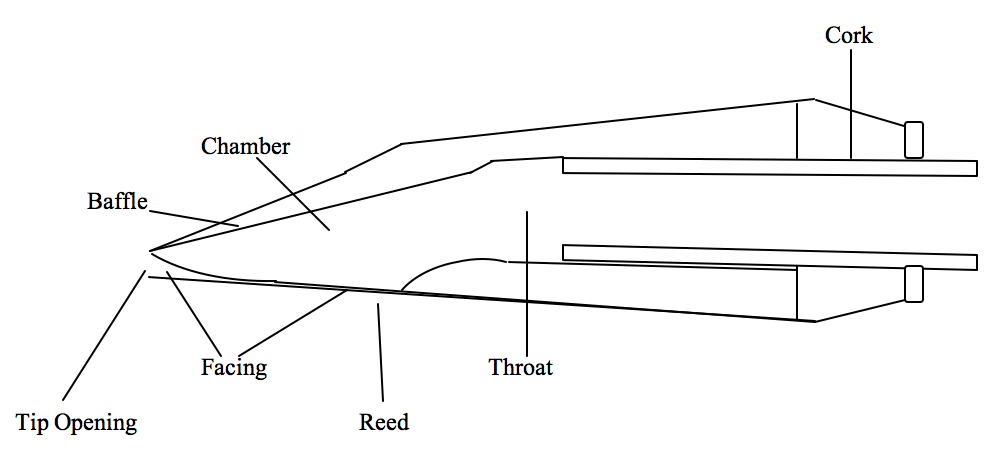













Proper reed selection is very important because the reed affects almost every aspect of saxophone performance especially tone, intonation, response, range, embouchure
formation and endurance. There are many brands of reeds being produced from cane grown in various country regions and since there are so many reed brands to choose from, it is necessary for saxophonists to narrow down the choices by getting recommendations from saxophone teachers, professional performers and peers.
After this task is accomplished, saxophonists should test play samples of the remaining reed brands to determine which one best suits their playing style. In addition to the reed brand, other factors such as reed strength and reed cut should also be carefully considered when making a reed selection since they play a large role in how well a reed performs.
Reed Brands
There are numerous reed manufacturers currently marketing saxophone reeds. However, two major companies, D’Addario and Vandoren, offer the most variety. D’Addario currently produces the following reeds: Rico, Royal, Reserve, Plasticover, Hemke, Select Jazz and La Voz. Most of D’Addario’s reeds are designed for both classical and jazz performance but two of their reeds, Select Jazz and La Voz and designed especially for jazz and commercial performance.
Vandoren also produces a variety of saxophone reeds including Juno, Vandoren Traditional, V12, V16, V21, Java, Java Filed Red Cut, and ZZ. While Vandoren Traditional, V12 and V21 reeds are designed for both classical and jazz playing, jazz and commercial saxophonists primarily use Vandoren V16, Java, Java Filed Red Cut and ZZ reeds.
It is difficult to designate a reed as either for classical or jazz performance since the mouthpiece used and the saxophonist’s playing style also greatly affects the overall tone. However, classical saxophone tone requires a reed and mouthpiece combination that produces a dark, mellow sound with little or no edge and in general, jazz saxophone tone requires a reed and mouthpiece combination that produces a brighter sound with more edge. It is recommended that saxophonists try a variety of reed brands and cuts, both classical and jazz, to see which one works best for their performance situation.
Reed Strength

Reed strength refers to the softness or hardness of a reed and usually correlates with the density (stiffness) of the cane. Most reeds are labeled with numbers ranging from 1 through 5 and as the number increases, so does the density (hardness) of the reed. These reed brands also have strengths that increase in one-half number increments while a few increase in one-fourth increments. Some reed brands, like La Voz, use labels such as soft, medium soft, medium, medium hard and hard to grade the density of cane instead of numbers. Regardless of the labeling system used, saxophonists should be aware that reed strength is not a standardized unit of measurement and may vary greatly from one reed brand to another.
Factors used to determine the correct reed strength are the type of mouthpiece, mouthpiece facing, tip opening, performer’s embouchure strength, breath support and playing style. Saxophonists who use correct reed strength will have a better chance of playing comfortably in tune and with a good tone.
 Determining and Increasing Reed Strength
Beginning saxophonists usually start with softer reeds due to a weak embouchure, but as their embouchure strength and breath support develop, harder reeds are used. When increasing reed strength, saxophonists should gradually move up in one-half number reed strength sizes instead of whole numbers, which allows the embouchure time to adjust. For example, a saxophonist playing on a number 2 reed should move up to 2.5 before going to a number 3.
By increasing reed strength, a saxophonist’s tone quality, intonation, range, dynamic contrast and other factors are usually improved. However, the process of increasing reed strength has led many saxophonists to believe that the harder the reed strength used, the better the tone. This myth is not true, and saxophonists should be cautious when moving up to harder reeds. Saxophonists who play reeds that are too hard will have an airy unfocused tone, instrument response problems and premature embouchure fatigue.
On the other hand, reeds that are too soft will cause poor tone quality, response problems especially in the upper register, and intonation problems with the pitch going flat. This in turn may affect the embouchure, as the saxophonist will attempt to put too much embouchure pressure on the mouthpiece to pull the tone up to the correct pitch.
A guide to assist saxophonists in reed selection is the larger the tip opening of the mouthpiece, the smaller the reed strength number. Therefore, mouthpieces with smaller tip openings will require a higher reed strength number. It is important for saxophonists to choose the correct reed strength as this will produce a full tone, create good instrument response, promote good intonation and alleviate premature embouchure fatigue.
Filed and Unfiled Reeds

Another aspect to consider when selecting a reed for saxophone performance is the cut, either filed or unfiled. A filed reed, sometimes referred to as double cut, has a thin layer of additional bark removed just below the vamp area allowing the bark to form a straight line. This additional cut allows the reed to vibrate more freely producing a brighter sound with better response.
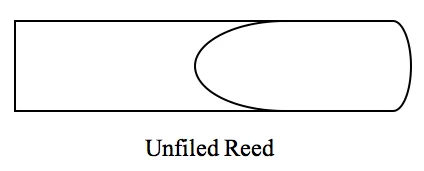 An unfiled reed, sometimes referred to as a single cut, does not have the additional cut with the bark forming a “U” shape in the area below the vamp. This cut produces a darker tone with more resistance, as the reed is not as free to vibrate. Saxophonists should test play both filed and unfiled reeds to see which cut works best with their mouthpiece and playing style.

Synthetic Reeds
In addition to cane reeds, some reed manufacturers also produce reeds that are made from synthetic materials. Legere, Forestone, Fibracell and Bari are all manufacturers of synthetic saxophone reeds. The reeds are not affected by temperature and moisture changes and last much longer than conventional reeds. Synthetic reeds are made entirely from man-made materials and have no cane in them.
Although much more expensive than a traditional cane reed, these reeds will last a very long time. Synthetic reeds also do not have to be broken in, nor do they have to be wet to play. In addition to being played under normal circumstances, doublers sometimes use these reeds in situations where they are required to pick up an instrument that has been idle for a while and play it instantly without having an opportunity to wet the reed.
Since these reeds are also more durable than conventional cane reeds, they are sometimes used for marching bands and other outdoor performance events. However, synthetic reeds do not have the same feel as traditional cane when played and the tone might be quite different. For these reasons, many saxophonists choose to play traditional cane reeds.
Purchasing Reeds
Once the reed brand, cut and strength have been determined by playing samples of each reed, it is time to purchase reeds for use. When buying reeds, it is always best to purchase them by the box.
When reeds are made, they are mass-produced by machines that cut the reed based on the thickness of the cane. They are then packaged in boxes of ten for soprano and alto saxophones and boxes of five for tenor and baritone saxophones. As a result of their mass production, there are usually several reeds out of each box that will not play well or not at all. If purchasing only one or two reeds at a time, the saxophonist may receive the reeds out of a box that do not play. By purchasing the entire box of reeds, the performer is assured of getting a selection of good reeds. Also, reeds are less expensive when purchased by the box, especially through online stores who sell mass quantities of reeds at close to wholesale prices.
If saxophonists decide to purchase only one or two reeds from a local music store, they should ask the sales associate if they could select the reeds from the box rather than accepting what is handed them. If saxophonists know what to look for when selecting a reed, they can pick the best reeds from the box while avoiding the reeds that do not play well.
When looking for the best reeds, saxophonists should examine the reeds by holding them up to a light. Good reeds will have a thick middle section called the heart, with the cane gradually tapering to the edge of the reed. The density of cane should be symmetrical on each side of the heart so the reed will be balanced. A balanced reed vibrates evenly on both sides because the cane has the same density.
Saxophonists should also look for a smooth vamp, which is the shaved portion of the reed. Vamps with coarse reed fibers may not perform well and may also be uncomfortable to the lower lip. By following these suggestions, saxophonists will increase their chances of purchasing playable reeds while avoiding the bad ones.
Summary
For saxophonists, proper reed selection is very important since the reed affects almost every aspect of performance. Factors such as the reed brand, reed strength and reed cut will determine how well a reed performs and should be carefully considered when making a reed selection. Through diligence, patience and carefully play-testing a variety of reeds, saxophonists should be able to select the best reed for their performance needs.