A metronome is most useful when it helps musicians hear what they are doing between the clicks. Set it, play a short passage, and ask a specific question: Which entrance drifts? Does the group slow through the rest? Can the phrase keep moving when the click becomes less frequent?
Choose four measures the ensemble can play without struggling for notes. Begin with a quarter-note click in a simple meter. If students lose the pulse immediately, shorten the material before changing the device. The metronome should expose a manageable problem, not accompany a passage the class has not learned.
1. Match, then explain
Clap four quarter notes with the click. Repeat the task with an easy instrumental pattern. Ask students whether they were ahead, behind, or together on the last attack. Listen again. Different answers are a reason to repeat and compare, not to vote on who was right.
Keep the tempo unchanged for several attempts. Write the musical task beside the setting so "72" means something more useful than a number on a practice log.
2. Carry a rest
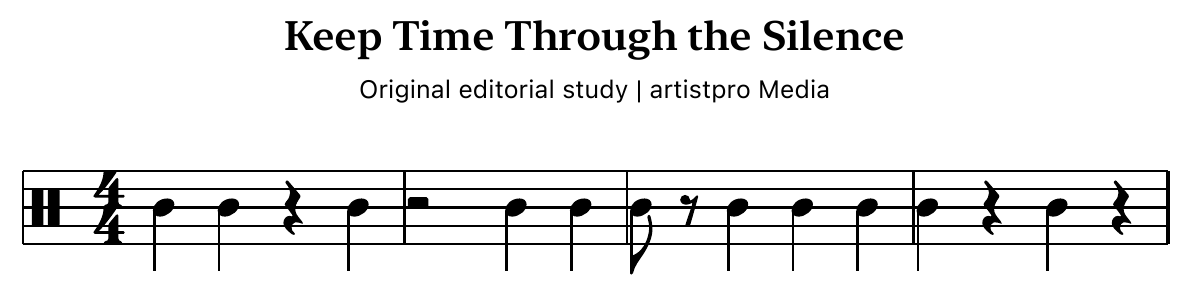
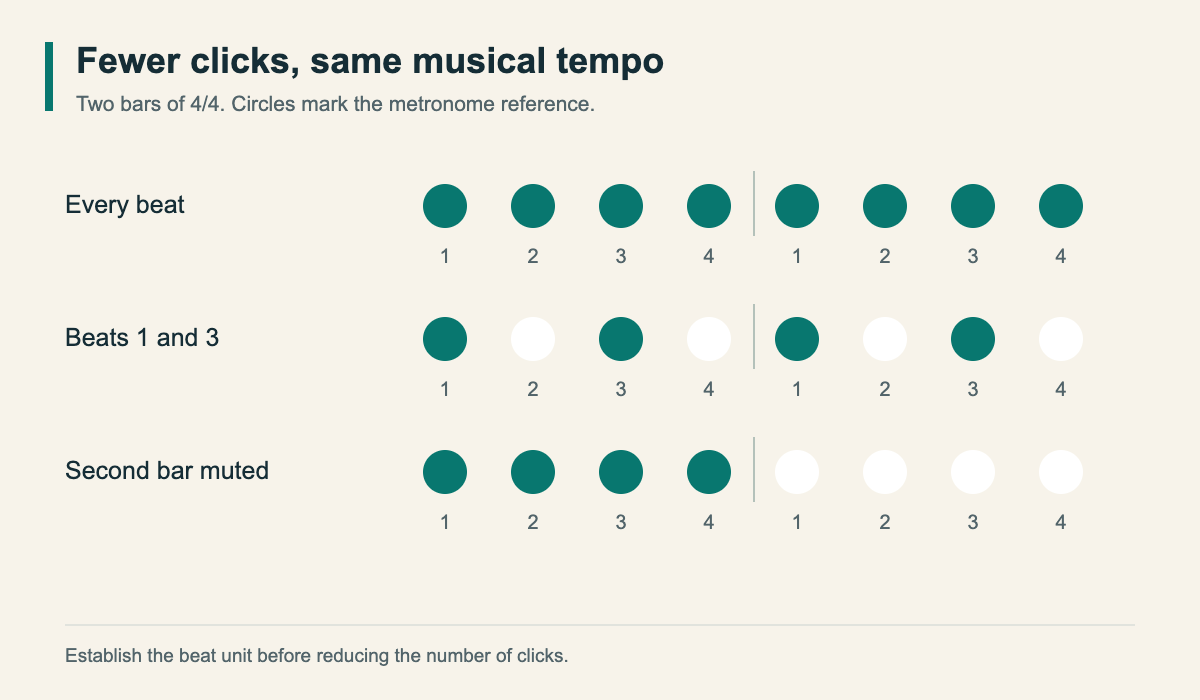
Use the rest study supplied with "Teach the Rest Before You Count It." Play two measures with the click and two without it. A teacher can mute the device at a bar line while continuing the pulse silently. On the return, compare the next attack with the click.
If the class repeatedly returns early, keep an external pulse available to one small group and let the others listen to that group. Reduce support only after students can describe what they are trying to maintain.
3. Give the click fewer jobs
In 4/4, a click on beats one and three can reveal whether students maintain the intervening beats. To retain a quarter-note tempo of 80, set an unaccented metronome to 40 and explicitly establish which beats the clicks represent. Count in at 80 before beginning.
Do not halve the setting without explaining the new relationship. A student may reasonably hear a slower tempo rather than fewer reference points within the same tempo. Return to four clicks per measure whenever the relationship becomes unclear.
4. Pass the phrase
Divide a four-measure phrase among two or more groups. Each group plays its assigned measure while everyone tracks the full phrase. The handoff is the task. A group that waits to hear its own entrance before preparing will tend to arrive late.
Start with the click throughout. Then let a student keep the pulse by a quiet, visible gesture. Finish with the phrase performed without that external cue. Give seated or nonmovement alternatives when needed.
5. Compare the return
Play the same four measures twice without a click. A teacher or student observer brings the metronome back at the start of the fifth measure. Discuss the size and direction of the difference, then identify where the phrase was most likely to move.
A recording can help if it is permitted and practical, but it is not required. Another option is a small listening group that observes while classmates perform. Rotate the job so listening is part of everyone's work.
Write down the musical result
Use a log with passage, beat unit, tempo, click pattern, and observation. "Entered early after the two-beat rest" gives tomorrow's rehearsal a starting point. "Practiced with a metronome" does not.
Students should eventually make a phrase without the device and still shape it musically. Where a score calls for an expressive change of tempo, teach that change deliberately. A fixed click is a reference for the exercise, not a rule that every performance must obey.