A student can name a quarter rest and still arrive late on the next note. Recognizing the symbol and keeping time through the silence are separate skills. Teach both, and listen particularly closely to the first sound after the rest.
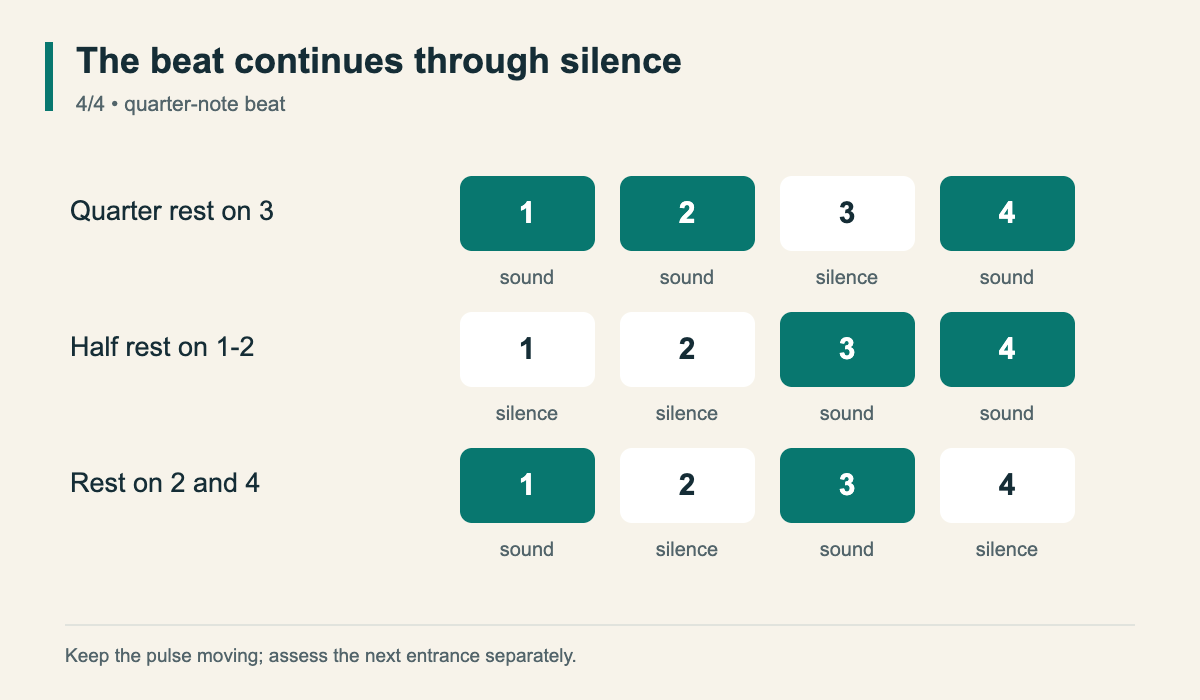
Start with a four-beat pattern the class can already perform. Keep the pulse at a comfortable walking pace. Students may tap one finger, shift weight, or make another small, accessible movement. Play or clap four even sounds; then repeat the pattern with the third sound missing. The movement continues. Ask students where the next sound belongs before showing any notation.
Make the silence part of the pattern
Echo a one-measure pattern several times. On the next repetition, replace one clap with a silent outward gesture. Keep the gesture small enough that it does not become a new accent. Students should be able to feel the missing attack without stopping the measure.
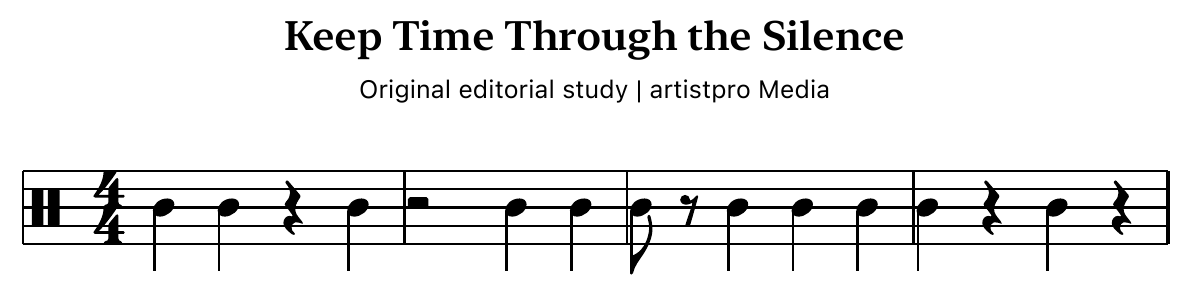
Use the accompanying score in 4/4: quarter note, quarter note, quarter rest, quarter note. Ask half the class to maintain the pulse while the other half performs. Exchange jobs. Then have the performers take responsibility for the pulse themselves.
If the last note arrives late, return to the spoken sequence before adding the instrument. If it arrives early, ask students to show the entire silent beat with their movement. Repeating the same explanation more loudly will not reveal which problem they are having.
Attach the symbol to something students can do
In 4/4 with the quarter note as the beat, a quarter rest lasts one beat, a half rest lasts two, and an eighth rest lasts half a beat. Those beat counts belong to this metrical setting; a rest does not carry a fixed number of seconds. The half-rest symbol sits on a staff line. A whole-rest symbol hangs below a line, and it can also indicate a whole measure of silence.
Show the first two measures of the score. In the second, students remain silent for beats one and two, then play on three and four. Have them trace the two silent beats with two separate motions before the entrance on three. Do not turn the half rest into a long pause whose ending depends on the teacher's cue.
For eighth rests, subdivide aloud: "one-and, two-and, three-and, four-and." In the third measure, the first sound lasts through "one" and the rest occupies "and." The next attack is on two. Establish that placement by speaking and moving before asking for instrumental performance.
Fix the entrance, not just the label
Check three things separately: Did the student identify the rest? Did the pulse continue? Did the next attack fall in the right place? A student who names the symbol correctly but rushes through it needs timing practice. A student who echoes accurately but cannot connect the sound to the page needs a reading task.
For learners who cannot clap or step comfortably, use a finger movement, an eye-gaze choice between numbered beat boxes, or a spoken response. Keep the musical demand clear while changing the response method.
A two-minute exit check
Perform the fourth measure without counting aloud. Ask students to mark the silent beat, explain its duration in this measure, and perform the next entrance twice. Accept a spoken explanation, pointing, or a short written answer.
Tomorrow, place the same rest pattern in a short phrase from the ensemble's music. The test is whether students carry the pulse into that phrase when the rehearsal moves on.