





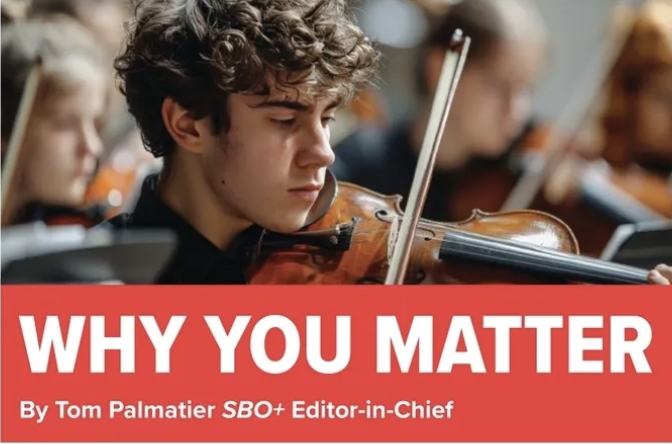
By Tom Palmatier, SBO+ Editor-in-Chief
I have recently found myself reflecting on what we do as music teachers in relation to what’s going on around us. What is going on around us? Many teachers are finding themselves caught up in disagreements about what is taught and how it’s taught with administrators, parents, commentators, influencers, and media seemingly all convinced only they are right. I’m not smart enough to know who’s the “rightest” but it seems like what’s best for the student is not always their priority. Notice that I said student rather than students because we all know every kid in our classroom learns differently and has different strengths, weaknesses, and needs.
Add to this the disconnect in many cases between what higher ed is teaching new music teachers and what they really need. I shudder to think of how horribly prepared I was teaching beginner instrumentalists while I was well-versed in music of the ars antigua and ars nova. Was that what I needed as a new band director? Of course not, but that’s what my professor liked to teach so that’s what I got. How many of us hacked through piano etudes in our keyboard classes, but never learned how to “comp” from chord symbols. How about being exposed only to Grade 5 and 6 music in ensembles but not learning how to pick high quality literature at Grade .5 to 2?
So, why should we dedicate our lives to teaching in the arts and music specifically? Because it DOES make a difference! I was discussing this with a friend who has a background in coaching personal performance. This person is not a musician but is an acute observer of people and how they learn and perform. Their observation was that artists of all ages display a much higher level of sustained emotional, social, mental, and physical engagement than those in any other discipline. When I’m working with honor bands I frequently tell them I’m not the least bit demanding. All I ask of them is 100% of their physical, emotional, and mental energy at all times! Then I ask them if any of their academic teachers ask for the same all-in commitment, usually eliciting laughs.
One of my many “side hustles” is managing a ballet studio that I co-own with my daughter who is a fabulous ballerina and teacher. She has students as young as three years old and the level of concentration and commitment required in that very difficult art form is extraordinary. Again, my friend pointed out that what the arts are really developing in young people is the ability (and willingness!) to maintain a sustained focus without distraction. Why is that important? Electronic devices are demonstrably shortening attention spans in people of all ages and many students struggle to maintain a sustained focus on anything for more than a few moments. Only studying and performing the arts develops that discipline. Even more notable is the arts’ emphasis on collective performance where a high level of teamwork, collaboration, cooperation, and compromise is needed to excel.
So, you may feel that only STEM or sports is valued in your school. But only YOU engage students socially, mentally, physically, and emotionally in a collective and focused manner that other disciplines never even attempt.
Two recent experiences help me feel optimistic about the future of arts education. I’ve mentioned previously I was recently named to the Board of Directors of The Music Teacher Guild. This non-profit organization supports continuing education for music educators and instructors and offers practical and accessible professional learning for musicians desiring to develop their repertoire of instructional skills, pre-service and in-service educators seeking to fill the knowledge gaps between university methods courses and the K-12 classroom, and in-service educators seeking extension opportunities to increase their repertoire of teaching skills, ensuring continuing licensure and job growth. I’m really excited to be part of a group of educators dedicated to providing substantive help to other teachers.
The other was in a VERY different setting but no less encouraging. I was recently asked to be a director/coach for the Colorado Jazz Workshop. The Workshop hosts weekly rehearsals of big bands and combos where musicians rehearse high level charts and hone improvisational skills. Let’s think about that. They pay to rehearse difficult literature. Every week, the room fills with musicians wanting to be challenged. Where, other than the arts, does something like that occur?
This issue announces the results of our first Teachers’ Choice Awards. The music business has changed radically over the last few years. Increasingly, the key decision makers about what products are purchased by schools and parents is the music teacher. The music industry wants to know what you value and you have spoken. Don’t forget to nominate someone to be featured in our 50 Music Teachers Who Make a Difference issue!
This month and next, we will attend two of the best professional development events for music teachers. Visit us at Midwest Booth #1813 and NAMM Booth #6611. See you there!