










 Before discussing the important details of picking a good, and stylistically appropriate, saxophone mouthpiece, it is important that the fundamentals of a good embouchure are present. No mouthpiece and reed combination will sound the way they are designed without them.
Saxophone Embouchure
All of us are genetically unique. This makes absolutes difficult when teaching. As educators, it is important to realize that tweaks and adjustments may need to be made to find the best results with each student’s variations in teeth, mouth, and lip sizes and shapes. With this in mind, here is the process I teach beginners and advanced players to think about their embouchures to get the best possible results.
Step 1: Bottom Lip Over Your Bottom Teeth
The bottom lip is our contact point with the reed. It is where we gain control of the reed’s vibrations. If someone were to put their bottom teeth on the reed, the reed would produce a high-pitched squeak that was wildly out-of-control. The cushion of the lower lip acts as a “shock-absorber” that can ensure a rich, dark sound emerges from the reed’s vibrations on the mouthpiece. While lip sizes vary tremendously, a good starting point is to take ¾ of the lower lip inside of the mouth.
Step 2: Say “Mooooooo”
While keeping the lower lip inside the mouth, say “mooooo,” (like a cow). This brings the corners of the mouth forward and ensures a proper seal around the mouthpiece. It also thickens the lower lip up, increasing surface area contact with the reed. Lastly, it activates the zygomaticus muscles in the face that are necessary for a good embouchure.
Step 3: Top Teeth Down
Place the top teeth (both central incisors) down atop the mouthpiece – ideally upon a thin mouthpiece patch. The grip should be firm enough that the mouthpiece won’t move, but not so firm that we inhibit reed vibration and function. Students who grip the mouthpiece too firmly, creating a host of tone, articulation, and intonation problems.
Saxophone Mouthpiece Selection
Selecting the right mouthpiece is an important step up for a young saxophonist. While there are many philosophies to mouthpieces and budget, I strongly encourage putting beginners on professional quality mouthpieces with a good reed. On a student-line instrument it will produce great sounds, while the best professionals will struggle to make a student-level mouthpiece sound great. Note: there are many different mouthpiece makers that use a variety of materials (hard rubber, plastic, glass, metal, wood). Professional jazz musicians use a wide array of these material types, but for a more classical sound that is traditionally embraced in the concert band and orchestral worlds, most professionals use mouthpieces made from hard rubber, much like the clarinet.
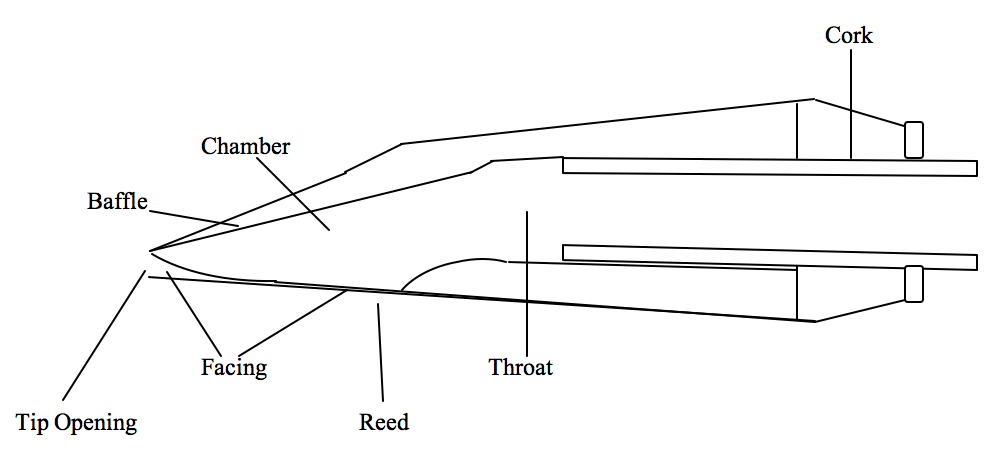
Mouthpiece Design While there are many variables that impact the sound of a saxophone mouthpiece, two matter most when selecting a professional mouthpiece for students: tip opening and bore shape. While facing length and chamber are also variables, those won’t be discussed in the confines of this column.
There are two contrasting designs for mouthpieces, usually marketed as “jazz” and “classical” mouthpieces. While this is an over-simplification, typically classical mouthpieces have a smaller tip opening and jazz mouthpieces have a larger tip opening. This necessitates a different reed strength. The bigger the tip opening of the mouthpiece, the more flexible the reed must be (or “softer”). For a less open-tipped mouthpiece, a harder reed is often more desirable. For many years, a square chambered mouthpiece produced a preferable sound (like the Selmer S-80 C*), but the modern aesthetic has shifted and we are seeing a preference for round chamber mouthpieces again (Vandoren Optimum AL3, Vandoren Profile AP3, and the Selmer Concept).
Typically, the round chamber provides a more even sound across registers and is slightly darker. The square chamber provides slightly more edge to the sound, which helps with projection. While a smaller tip opening is easier for a developing saxophonist to get consistent response and articulation, a bigger tip opening usually provides a brighter sound, and is embraced by the jazz style (Vandoren V16 series mouthpieces). Hard rubber, or ebonite, is the most common mouthpiece material, but metal mouthpieces are also common for jazz mouthpiece designs.
Budget Professional saxophone mouthpieces can range in price from around $120-$700, but as a general rule, a classical mouthpiece typically runs from $120-$300 and a jazz mouthpiece is typically between $150-$700. Hard rubber mouthpieces are on the lower end of the cost spectrum and metal mouthpieces on the higher end.
Player Age and Skill Level For a beginner, a less open-tipped mouthpiece with a round chamber, like the Vandoren Optimum AL3 will give a consistent and round sound across all registers. As a player matures and desires more flexibility and projection, she/he may seek out a more open-tipped mouthpiece. For a more mature musician, try Vandoren Profile AP3 or the Vandoren Optimum AL5. For a jazz musician, it really depends upon player sound preference. Many saxophonists who primarily play jazz, will select a mouthpiece with a wider tip opening and play a softer reed. I personally play more on the “classical” side but also doubles in jazz, I prefer a more closed-tip jazz mouthpiece as it more closely resembles the resistance I get on my classical setup.
For a young student buying her/his first jazz mouthpiece, use a smaller tip opening for initial success. However, if a jazz educator has very strong opinions about tip opening and reed strength, trust what they suggest.
When looking at mouthpieces you will see a series of numbers (or letters like Selmer Paris) that correspond to the tip opening of the mouthpiece. One model mouthpiece (Vandoren Optimum) will have multiple tip opening sizes (AL3, AL4, AL5). Generally, the bigger the number, the bigger the tip opening. This is not a universal, so it is important to check with each manufacturer to confirm their system.