





 Now for all you “macho” band directors out there, you may not be too impressed with a lot of “Mickey Mouse” in your band room environment. Especially, when you’re playing “Gladiator”. But that is not what this article is about. Tying our band class to academic achievement is the topic of today’s school instruction. All to some day be centered around Common Core Standards the new big words of the day.
For most high school and middle school band directors trying to find commonality with academic subjects is not what we are thinking about most of the time. Our minds are on “Will we finish that field show in time for the next football game?” or “Why can’t the trumpets get bar 27?” and “Why are the clarinets so flat?”, et cetera.
Our minds are constantly on what is happening in the band room. Very little time is spent on how a Common Core fits into our world, until we attend a faculty meeting and the assignment is to find “Cross-Curricular Commonality in today’s Common Core Reality.” What? It’s OK, for all my life I thought the “#” sign was called a Sharp. Now it’s a hashtag. Where did that come from? At least I know that a Sharp sign actually does something.
For years, we have all known academic and social benefits to music instruction as it relates to other areas our students face. We know that music and math are similar because problem solving helps in developing neural connections in the brain. We know that the study of music is related to history and can be directly associated with what is going on around us. We know music is a language based on symbols and graphs. We know that music can be used in studying emotion through time. The incredible amount of self-discipline that it takes to play an instrument augments the structure of most academic learning both mentally and in the classroom environment.
Personally, I like to use simple examples. Like we teach Geometry in Marching Band. How, in street marching the band block is a geometric design based on the students watching their diagonals. If everyone is “IN” their diagonal correctly, the entire block becomes one. You can even bend that diagonal, and it is still a geometric design. Kids can see and relate in a real setting as to what three dimensional design is. We do that on the football field when we teach kids how shapes can smoothly change from one position to the next if they understand the geometry behind the movement.
When my bands travel to China every four years, I make sure our World History teachers know so they can take advantage of the trip to give the study of the Chinese Dynasties real meaning to the students attending. They will actually see it. I know many band directors who tie in their band tours with the historical heritage of the area they are going to. Even the music we play has powerful meaning if the students are made aware of what the work was about and the history behind it.
Now, back to Mickey Mouse. Over my 40 years in music education as a high school band director, I have taken my band down to Disneyland about seven or eight times to do the daily parade. It was extra work for me, but lots of fun for the kids. However, the past 25 years we have been doing concert tours to Hawaii, Canada, Colorado, Washington, D.C. (Clinton’s inauguration and the WWII Memorial dedication), Italy, and four trips to China, but not back to Disneyland. When my students asked to take a short trip (about six hours) down to Disneyland, the professional side of me thought this trip was a little “wimpy” compared to our upcoming plans for a fifth performance tour back to China.
I finally gave in, but this time I added the Disneyland Performing Arts Workshop to our parade performance package. What I witnessed shocked me as a music educator. For two hours, every one of my band students sat without saying a word, except when asked, and listened to every word our clinician said. We had the honor of working with Joe Alfuso, a freelance composer who is the senior arranger and orchestrator for Disney, and has conducted several major orchestras.
To my surprise it was not just about having the band play to a Disney movie. It was really about the “Science Of Sound.” The science of recording sound can and is always a challenge, especially when recording a high school band. There are sounds that the microphones pick up that we, as humans, tune out automatically. However, as Joe said to the band, “Recordings tell no lie.” You can hear every wrong and out of pitch note.
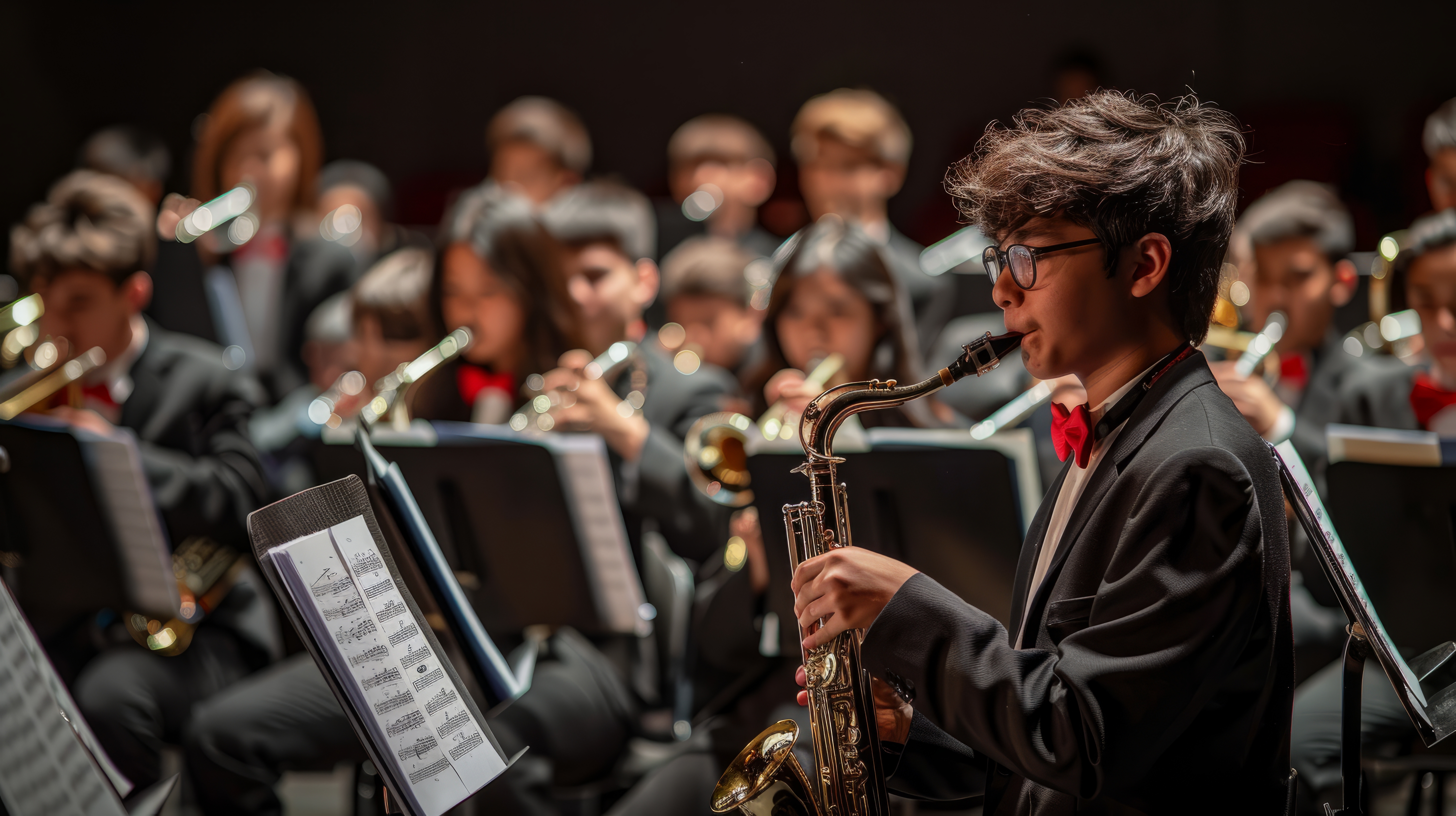
As band directors we fight the battle of sound by addressing intonation, tone, color, pitch, balance, and blend on a daily bases. Naturally my students were a little nervous at first and wouldn’t you know it the first thing that comes out in these kinds of clinics is INTONATION PROBLEMS. Suddenly they could hear on playback all those who were simply missing pitches in tune. Blend and balance are the second issues kids can hear almost immediately. You could hear that one arrogant tenor sax player who thinks he is the king of the band stick out like a sore thumb. But that was great, because intonation, blend, and balance are problems with most high school bands.
I guess my kids were really nervous, or just really tired from the end of a fun day and parade in the park.
This is where Mickey Mouse — John Alfuso, created the magic. By allowing the kids, each with their own recording headphones, to experience what a recording orchestra goes through to create great movie soundtracks, they worked in sections on actual reading the actual soundtrack music scores on four Disney movies. They took the time to discuss sound and forced the students to listen to what sound they are producing. And, listen they did. First recording: yucky, out of tune, balance, blend texture, all wrong, and not creating the emotion of the scene.
Then John started working his magic. He started talking about what was going on in the scene. Where in the music they could make big changes and how to pull the emotion being projected. And, of course, he addressed our obvious sudden intonation problem by simply listening. Instead of saying the word intonation, he used the word pitch. Finding the pitch.
After all that study, they recorded the same scene, and the “Magic of Disney” came alive. We continued on and did the same thing to three more movies over a two-hour period.
What was achieved in the Disney Recording Study session was much different than if you took your students into another recording studio to make a recording. This was a lesson in sound. The lesson being, “How sound is created, listened to, and recorded.” The art of electronic digital recording is complicated, but done right, with the right equipment and setting, it can be a rewarding and very real experience for your students. The Disneyland workshops are worth every penny.
Now I wish we could go back and try it one more time, this time tuning first. Oh well.
D.L. Johnson is director of bands — Emeritus, at North Monterey County High School, in Castroville, California. D.L. has previously written articles for SBO on various music subjects.