



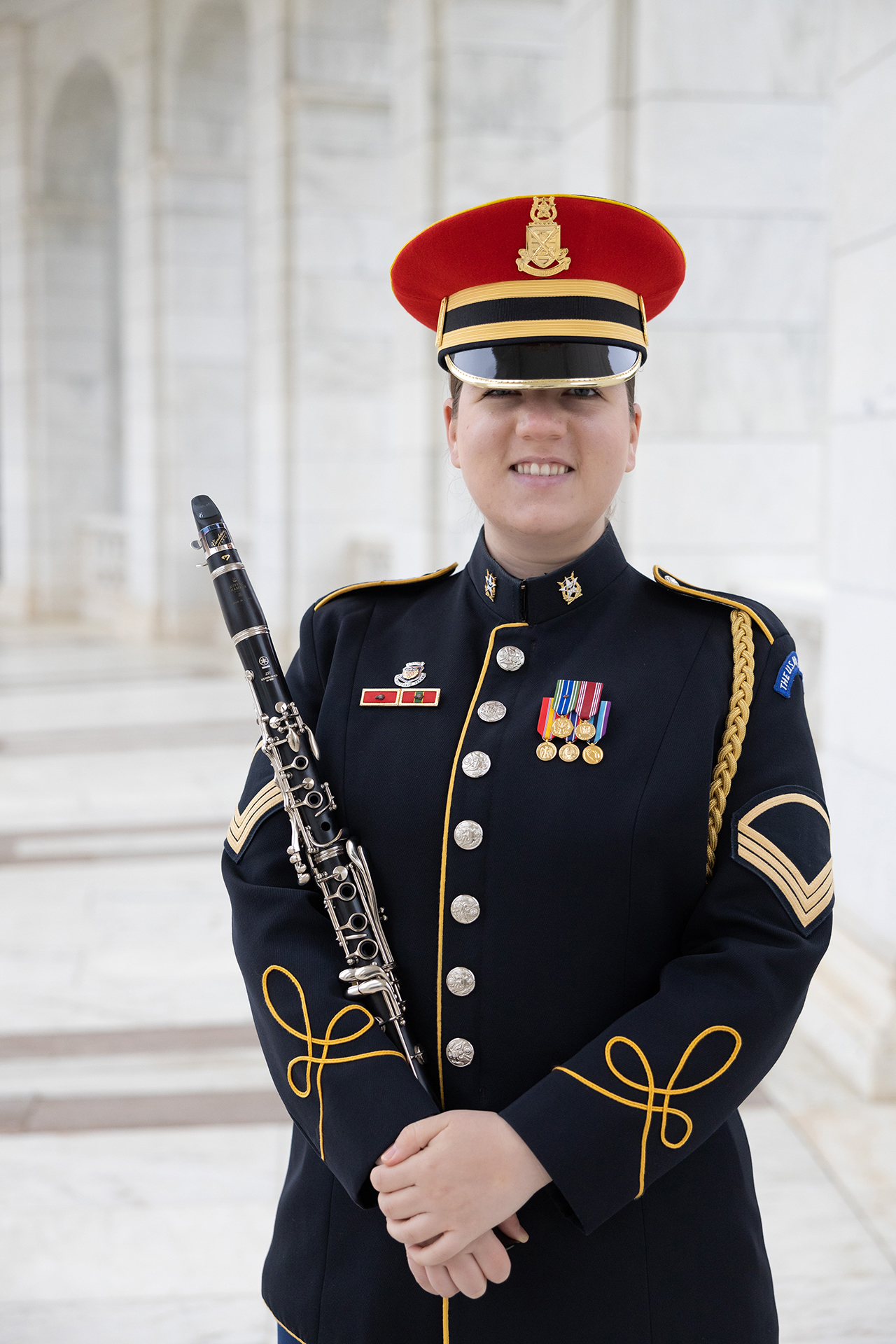

By Staff Sergeant Emily Kerski, The U.S. Army Band “Pershing’s Own”
You never know when a single lesson could change the course of your life. For me, it happened in my first year at DePaul University, where I was studying clarinet performance, eyeing a future career in administration or academia but ultimately unsure of anything except my passion for the instrument and the discipline of music. Our lesson had just concluded when my teacher mentioned an upcoming audition for the Navy Band, saying it might be a good fit for me, and thus illuminating the path to a purposeful career in music beyond what I could have imagined for myself. I nearly won my first audition, but it would take several more years and many more auditions (including 4 for my eventual spot at “Pershing’s Own”) before I got there. When I arrived, I discovered that my story of persistence through auditions was not unique; many of my colleagues journeyed the same road. Our shared determination, and our shared humility through service, gives us strong common ground.
Many people are familiar with military bands through the high-visibility events we support. Our performance on the international stage is certainly a key aspect of our mission and one we execute with pride, knowing the world is watching and that history is being made before our eyes. I have had no shortage of these significant moments in my early career: heart-stopping minutes when a newly-inaugurated President passes by the clarinet row during first military honors, marking the passing of Presidents in solemn procession, marching over a quiet Memorial Bridge for the Army’s 250th birthday, meeting First Ladies, cheering the public with holiday music during White House tours, and more.
And yet, especially as a member of the Army Ceremonial Band, many of our missions are closed to the public, and several have taken place in a whispered we were never here secrecy that is sometimes essential to mission security. There’s a sacredness, and an increase of our bond since we know we’ve delivered something special to that family, to that leader, or to that moment, unseen and unknown to anyone else. Many of our Pentagon arrival missions take place on a parking lot for a small contingent of leaders, without any public fanfare, yet we get to set the stage for pivotal discussions through our performance of each country’s anthem. Most of the missions I perform are full honor military funerals in Arlington Cemetery, for the families of fallen Soldiers. This is an especially sacred mission, and one which gives me purpose each time I play. We know that our music speaks to that distinct and deserving family, and as we perform at the gravesite we have the privilege of representing the Army one last time to that veteran and their loved ones. Small moments with great impact: paying tribute to returned POWs; saluting those with little family in attendance, but a full honor guard and band beside them; and at times standing so close to the families that the grief is palpable, and I hope our music transcends what is offered in words.
I often tell students and those who seek career advice that one of the best ways to grow your musicianship is simply to find ways to play with others; every career in music requires the ability to collaborate well, musically and personally! I believe that ensemble playing develops both skills profoundly. Little did I know that my time playing in clarinet quartets from high school through graduate school was building the skills I would need to perform well in our small band formations, or that my experience producing chamber music concerts purely for the enjoyment of it in college and my freelance career would lead to my current position as director of chamber music. Every lesson learned, and yes, every mistake, has taught me something valuable to apply to the benefit of the band. You never know how these seemingly small experiences will pay dividends to your future.
And so, it is the small moments which can yield the deepest resonance: watching tears fall on a Vietnam veteran’s face during a tribute concert, perhaps feeling appreciation of service for the first time; the understanding smile shared with a colleague as we prepare for a mission in extreme temperatures, knowing we will give our best no matter the weather; the excitement I see in young faces as we march past, the full circle of remembering when I was in their shoes; the short but potent conversation I had with my graduate school mentor which set me on this path; the many moments of connection through music I have experienced in between. I suspect, at the end of my career, it is these small moments that I will treasure most of all.