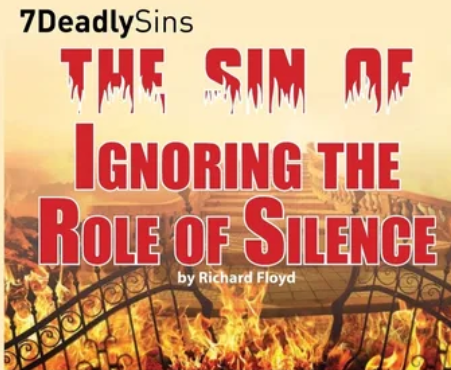









 This is the first in a multi-part series by the esteemed music educator Richard Floyd, based on his book, The Seven Deadly Sins of Music Making, reviewed in SBO in November 2021. While Floyd refers to bands, every “sin” is equally applicable to orchestras, so I urge our string colleagues not to overlook this article.
On occasion I still wonder why I came up with the book title The Seven Deadly Sins of Music Making. It just kind of “rolled off my tongue” in a conversation and suddenly I was immersed in the challenge of attempting to find the essence of what that might mean in our educational world of music making. To be honest, I was clueless as to how I might proceed, but it seemed like a good idea at the time. I stargazed that a good place to start might be to go back and reflect on the original deadly sins (often referred to as the cardinal sins) that can be traced back to the Fourth Century AD. Those sins were:
Lust
Glutton
Greed
Sloth
Wrath
Envy
Pride
Religious leaders through the centuries have proclaimed these sins to be transgressions that remain fatal to spiritual progress. A French monk even proclaimed there was an interconnected relationship between these sins. Thus, excesses in one vice could lead to transgressions in other indulgences and wrongdoings. A scary thought.
The challenge then melded into the endeavor to identify music offenses that might be viewed as transgressions that prove lethal to our musical progress. I concluded we certainly don’t intend to sin in our music making so perhaps our musical transgressions are evils of omission as opposed to sins of commission. Over several months of reflection and discussion with my wife Cheryl, I arrived at the notion our “sins of omission” could be distilled into the following:
Articulation
Dynamics
Rhythms
Tempo
Line
Silence
Proportion
But something was still missing. Those nouns got me closer to my vision but there was a specificity missing I was compelled to identify. After extensive reflection I added the following augmentations.
Generic Articulation
Unconvincing Dynamics
Perceiving All Rhythms Literally
Absence of Line
Ignoring the Function of Silence in Music
Failure to Consider the Role of Proportion
These enhancements and modifiers gave me the clarity I was seeking. Progress was finally being made!
Now you may feel the notion of all the above does not merit the severity of being called sins. If so, perhaps we could agree they are at least faults. In fact, one of the secondary definitions of sin is “an often-serious shortcoming or fault.” In any case, lack of attention to any of our identified transgressions clearly does diminish the artistry of our music making. Let’s look briefly at each of our sins, or faults, if you will.
Generic articulation. Every year I hear countless bands that employ a generic, basic approach to achieve some level of articulation. Yes, they start notes together and they employ note length to accommodate staccato, legato, tenuto and so on. But the notes are void of shape and/or personality and with little relationship to the context of the music that is unfolding.
Unconvincing dynamics. Bands are notorious for sacrificing dynamics to achieve balance and blend. We “play it safe.” Dynamic ranges are compressed to make the band “sound good.” In doing so, we fail to embrace one of the most expressive elements of music
Perceiving all rhythms literally. In many cases the rhythmic notation is only an approximation of the musical intent. Bruno Walter stated, “the measurability of musical rhythm, and therefore the accurateness of its notation, is only approximate.”
Being obsessed with tempo markings. In some cases, tempo markings can be an absolute, but not always! Unquestioned homage to a tempo marking doesn’t always achieve a desired musical result. There is always a “natural tempo” and it’s not the same for every piece of music and every ensemble.
Absence of line. Music travels through silence and tells a story. The beauty of music is not the notes but the relationships between notes and the journey they take. This essential element is line. Without it, the notes are static and lifeless. There is no music.
Ignoring the function of silence in music. There is a powerful musical message in silence. Silence is not simply a place to breath or regroup but silence plays an essential role in our musical journey.
Failure to consider the role of proportion. Relationships are an indispensable component of music making. They create relevance, unity, and contrasts in all artful endeavors. Proportion is present in countless guises in our music making.
In future installments we will dissect each of our sins and offer insights into how we might minimize our musical faults. Content will include briefly extracted glimpses drawn from The Seven Deadly Sins of Music Making by Richard Floyd.