A circle of fifths chart can answer a key-signature question in seconds. Learning to use it in music takes longer. Give students something to sing or play before asking them to memorize the entire wheel.
The chart arranges key names so that clockwise neighbors are a perfect fifth apart: C to G, G to D, and so on. Moving from C toward G, D, and A adds sharps to the major key signatures. Moving the other way, toward F, B-flat, and E-flat, adds flats. Enharmonic spellings allow the diagram to close, but the spelling still matters when reading a particular key.
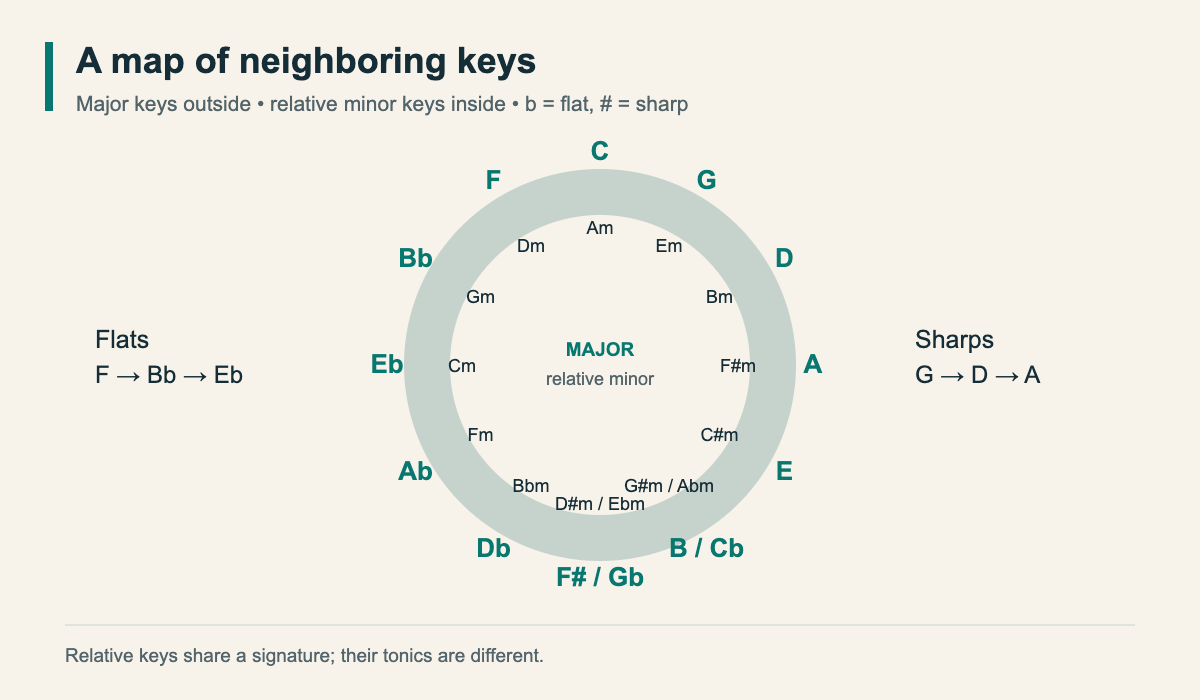
Keep those relationships visible. Then work with just three neighboring major keys: F, C, and G. Students do not need all twelve positions to begin making useful comparisons.
Begin with the changed note
Play a C-major scale and then a G-major scale, using the same register where practical. Write their letter names in two rows. C major contains C, D, E, F, G, A, B. G major contains G, A, B, C, D, E, F-sharp. The rows share six pitch classes; F changes to F-sharp.
Ask students to find that difference before you name it. Have one group play F-natural and another F-sharp as you alternate the two scales. The purpose is to connect the signature to a sound and a fingering, rather than treating the new sharp as decoration at the start of the staff.
Next, compare C major with F major. This time B becomes B-flat. On the chart, students can now move one position in either direction and explain a specific change.
Move a melody, not a pattern of fingerings
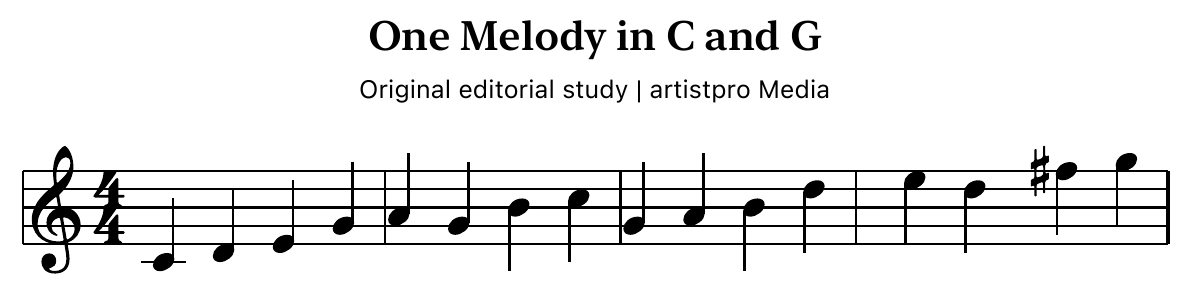
The accompanying apScore study gives a two-measure melody first in C major, then transposed to G major. Sing or play the first phrase, identify its scale degrees, and find the same degrees in the new key.
In C, the melody begins C-D-E-G; in G, it begins G-A-B-D. The second measure includes scale degree seven, making the F-sharp in G audible and necessary. Have students circle that note and explain why F-natural would change the written pattern of intervals.
Choose the octave and instrument grouping to suit the class. For transposing instruments, decide whether the exercise is in written or concert pitch before distributing parts. The supplied score is at concert pitch.
Find the neighboring chords
In C major, the chords built on F, C, and G occupy neighboring positions on the wheel. Use that relationship to locate IV, I, and V. Let students play simple voicings or single roots while another group performs a melody.
This is one use of the chart, not a claim that the wheel explains every chord progression. When a piece includes chromatic chords or changes key, examine the actual notes and musical context.
Separate relative keys from identical music
C major and A minor share a key signature. They do not have the same tonic. Play a short phrase that settles on C, then a different phrase that settles on A. Ask students which note sounds like home and what supports that answer.
A chart's relative-minor label is a starting point for investigation. It cannot identify a piece's key merely by counting accidentals. The melody, harmony, and cadences still need attention.
Ask for a small demonstration
Give students three tasks: name G major's key signature, transpose the first four notes of the study, and explain what changed from C major. If they can complete all three, the chart is beginning to serve their musicianship.