




• Latest
  • Trending
Guitar Tricks for Tricky Chords

Guitar Tricks for Tricky Chords

November 25, 2025
Bands are NOT the Same. And that’s okay!

Bands are NOT the Same. And that’s okay!

January 9, 2026
2025 Teachers’ Choice Award Winners

Teacher’s Choice Awards at the Midwest Clinic

January 9, 2026
Dorico Music Notation Software
NAMM Show 2026 – A Can’t Miss Event

NAMM Show 2026 – A Can’t Miss Event

January 6, 2026
BEGINNING BAND

BEGINNING BAND

December 30, 2025
New Products December 2025

New Products December 2025

December 30, 2025
Musical Detective: Why? When? How?

Musical Detective: Why? When? How?

December 22, 2025
Holiday Gift Guide for Music Businesses: Tools to Boost Engagement and Growth

Holiday Gift Guide for Music Businesses: Tools to Boost Engagement and Growth

December 21, 2025
The Perfect Culmination: How One Violinist Found His Calling in the U.S. Air Force Strings

The Perfect Culmination: How One Violinist Found His Calling in the U.S. Air Force Strings

December 19, 2025
The Road Ahead for Music and Arts Ed: Keeping it Human

The Road Ahead for Music and Arts Ed: Keeping it Human

December 29, 2025
The Power of Small School Music Programs

The Power of Small School Music Programs

December 29, 2025
Rehearsal AI: Transforming Artificial Intelligence into Authentic Musical Intelligence

Rehearsal AI: Transforming Artificial Intelligence into Authentic Musical Intelligence

December 15, 2025
Crafting a Creative Mindset for Band – Part 2

Crafting a Creative Mindset for Band – Part 2

December 14, 2025
Saturday, January 10, 2026
  • Contact
SBO+
Romeo Music
  • Subscribe Free!
    • Manage Subscription
  • Departments
    • Choral
    • String Section
      • String Section
    • Concert Band
    • Modern Band
      • Mariachi
    • Orchestra
    • Instruments
      • Woodwinds
        • Wind Talkers
      • Percussion
        • GoodVibes
      • Repertoire
      • Playing Tips
    • Marching Band
    • Resources
      • Fundraising
    • Jazz
    • Brass
    • General Music
    • Advocacy
      • NAfME Neighborhood
      • MAC Corner
      • MusicEd: Mentor Minute
    • Commentary
      • Bubbett’s Bookshelf
      • Leadership Tips
      • Perspective
      • InService
        • America’s Bandmasters
        • America’s Musicians
      • Tone Deaf Comics
    • Features
    • News
      • Headlines
  • Current Issue
    • Past Issues
  • Support
  • Awards/Entries
    • 50 Teachers Who Make a Difference
    • Teachers’ Choice Awards
  • Advertise
    • Email PR!
No Result
View All Result
  • Subscribe Free!
    • Manage Subscription
  • Departments
    • Choral
    • String Section
      • String Section
    • Concert Band
    • Modern Band
      • Mariachi
    • Orchestra
    • Instruments
      • Woodwinds
        • Wind Talkers
      • Percussion
        • GoodVibes
      • Repertoire
      • Playing Tips
    • Marching Band
    • Resources
      • Fundraising
    • Jazz
    • Brass
    • General Music
    • Advocacy
      • NAfME Neighborhood
      • MAC Corner
      • MusicEd: Mentor Minute
    • Commentary
      • Bubbett’s Bookshelf
      • Leadership Tips
      • Perspective
      • InService
        • America’s Bandmasters
        • America’s Musicians
      • Tone Deaf Comics
    • Features
    • News
      • Headlines
  • Current Issue
    • Past Issues
  • Support
  • Awards/Entries
    • 50 Teachers Who Make a Difference
    • Teachers’ Choice Awards
  • Advertise
    • Email PR!
No Result
View All Result
SBO+
No Result
View All Result
Sweetwater Sound

Guitar Tricks for Tricky Chords

bySBO+ Contributor
November 25, 2025
in Modern Band/Popular Music, November 2025
0
Guitar Tricks for Tricky Chords

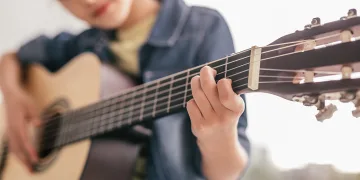
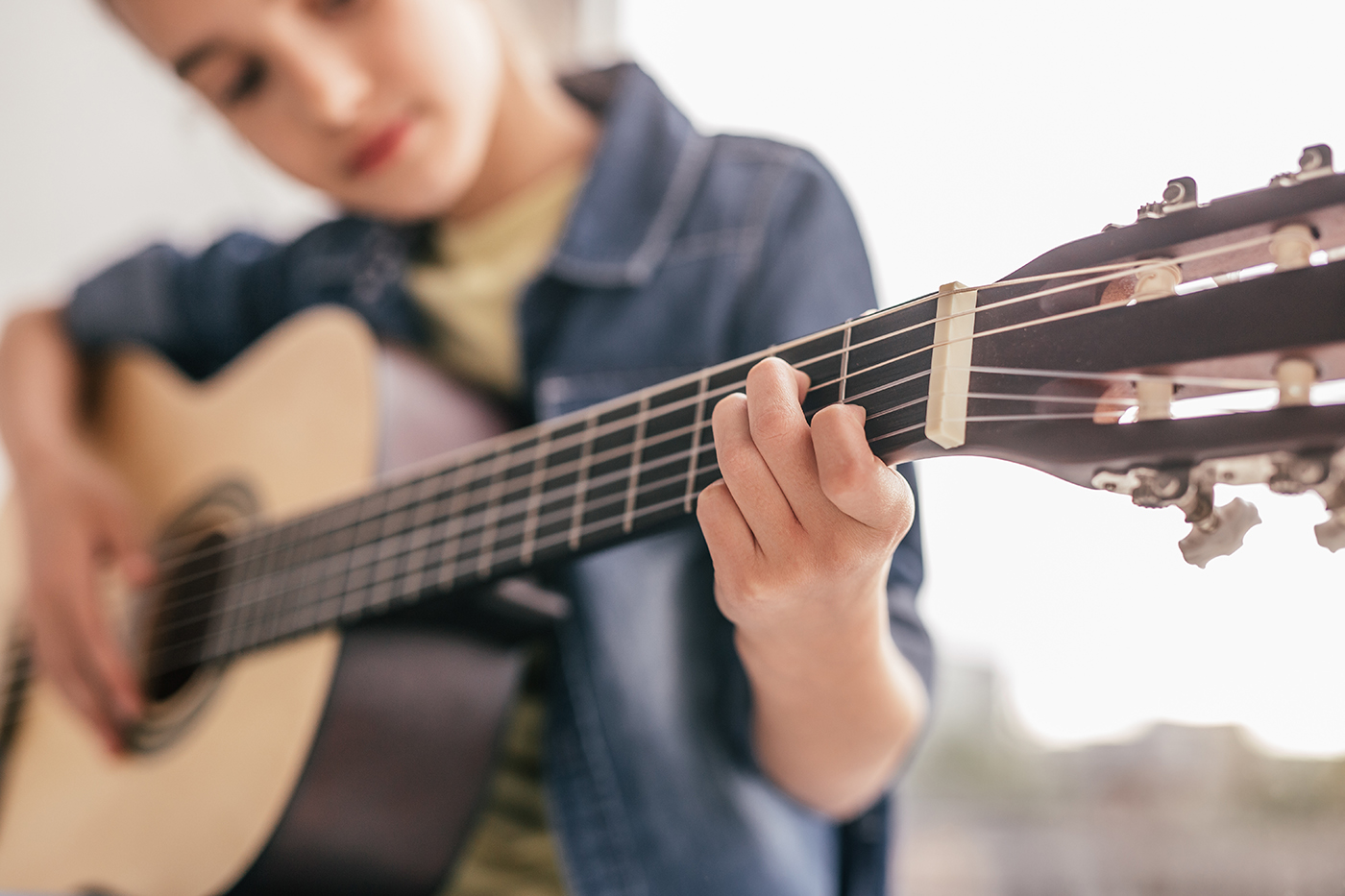
Blurred girl learning chords on acoustic guitar during individual music studies at home

Share on Facebook
ADVERTISEMENT

By Dr. Scott Burstein

If you have a guitar class or modern band that uses student-selected pop songs, there is a good chance this has happened to you: there is some new song on the radio they all want to learn, and it’s simple, just a few chords, but there is no way to avoid a tricky chord they don’t know yet, something beyond the basic eight open chords. Well, here are three different tips for getting past those roadblocks.

Recently I saw a group of high school students playing “Just Like Heaven” by The Cure (also what I like to call the happiest song by the saddest band), and it is by and large a perfect song for growing players – relatively simple form, just 5 chords throughout, and lots of opportunity for layering parts, from the guitar riff to the simple keys and piano melodies. The problem? Two of those chords are a B minor and an F# minor. Here are solutions for getting around them:

ADVERTISEMENT
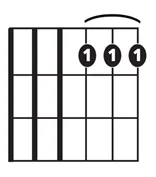
  1. The simple top strings barre. On guitar we tend to think of strumming all the strings and these large chord sounds, but often it’s more characteristic to think of simple triads like you might on keys. If you lay down your first finger on the top three strings (G-B-E), you have a minor triad that is moveable anywhere on the neck. The root is on string 1, so playing it on the 2nd fret will give you the needed F# minor chord.
ADVERTISEMENT

While this is a simple solution, it can be jarring to move from a full open chord to a sudden three string one, but still a good mid-solution while they build strength to play a fuller chord.

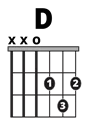
  1. Relative substitutions. If you have a larger group or a bass player, this is an ideal trick for keeping things moving. Take that B minor chord and think of the relative major chord (up 3 half-steps and two letter names) and you get a D major chord. If your guitarists play a D chord there while the bassist, keyboards or other guitarists play a low B in the bass, you end up with a Bm7th chord, which works well. You can do a similar solution on the F#m by playing an A major chord over an F#. Think of it this way, the Bm7 is just a B D F# A, where you are only playing the B in other instruments. Once again, this isn’t a perfect solution, the largest drawback is when students  practice or perform by themselves.
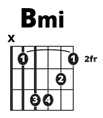
???  =   with B in other instruments

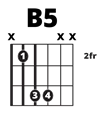
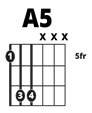
  1. Power Chords are your friend. If you aren’t familiar with power chords, they refer to a chord that doesn’t have a 3rd, particularly a root, fifth, and often another root on top.
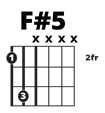
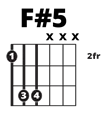
 

You can play them with just the root and fifth, or the octave. You can play them on strings 6-4 or 5-3, the note you play with your first finger is the root. They definitely have a different sound, but to keep things uniform, you can actually play all the chords of the song using power chords, even open chords like A and E.

While these are great tricks for getting through difficult parts of songs with harder chords, they are typically used on the road toward mastering barre chords, probably the biggest stumbling block for beginning guitarists. In my experience if your students are excited to learn, they will push themselves and go beyond what you thought possible! I have seen a class of grade 3-4 elementary students learn to play barre chords in the first few weeks. How? The teacher had them work on a song where they could play everything simply from the few open chords they have already learned except one B chord. He first offered them the solution of just playing a hybrid B of barring strings 5 through 1 with their first finger (resulting in a quasi-B9 sound), and soon the students were so excited to get it right, they added the rest of the fingers for the chord.  

ADVERTISEMENT

This is why giving students a voice in their education can be such an important tool. When they see the music they know and love reflected in their classes, they feel empowered and anxious to push themselves. As a teacher of guitar and popular music, you can find lots of solutions like these to make sure you can help them on this path when the music they want to play might be a bit out of their reach.

Dr. Scott Burstein is the Director of Strategic Initiatives for the non-profit Music Will. For more free resources, check out https://jamzone.musicwill.org/

MusicWill.org

You may also like:

Technology: Music Ed Apps Technology: Using Chords In Notion Vote Now for 2014 Best Tools for Schools The 22nd Annual 50 Directors Who Make a Difference SBO Presents the 20th Annual 50 Directors Who Make a Difference
ADVERTISEMENT
Previous Post

Three Characteristics of Leadership – Lessons for Music Teachers

Next Post

Dip Your Toes In: Practical Eclectic Styles Skills for the Classical Musician

Next Post
Dip Your Toes In: Practical Eclectic Styles Skills for the Classical Musician

Dip Your Toes In: Practical Eclectic Styles Skills for the Classical Musician

Please login to join discussion
Exclusive Content on artistpro.media
  • January 2026

    Articles | Digital Issue
  • December 2025

    Articles | Digital Issue
  • November 2025

    Articles | Digital Issue
  • October 2025

    Articles | Digital Issue
  • September 2025

    Articles | Digital Issue
© 2005 - 2026 artistpro, LLC
7012 City Center Way, Suite 207
Fairview, Tennessee 37062
(800) 682-8114

Wenger Endur Music Stand
No Result
View All Result
  • Subscribe Free!
    • Manage Subscription
  • Departments
    • Choral
    • String Section
      • String Section
    • Concert Band
    • Modern Band
      • Mariachi
    • Orchestra
    • Instruments
      • Woodwinds
      • Percussion
      • Repertoire
      • Playing Tips
    • Marching Band
    • Resources
      • Fundraising
    • Jazz
    • Brass
    • General Music
    • Advocacy
      • NAfME Neighborhood
      • MAC Corner
      • MusicEd: Mentor Minute
    • Commentary
      • Bubbett’s Bookshelf
      • Leadership Tips
      • Perspective
      • InService
      • Tone Deaf Comics
    • Features
    • News
      • Headlines
  • Current Issue
    • Past Issues
  • Support
  • Awards/Entries
    • 50 Teachers Who Make a Difference
    • Teachers’ Choice Awards
  • Advertise
    • Email PR!

© 2005 - 2024 artistpro, LLC 7012 City Center Way, Suite 207 Fairview, Tennessee 37062 (800) 682-8114