







By Antonio J. García
Whenever I guest-direct an honors or community jazz ensemble, colleagues have valued the positive effects and efficiency of my tune-up process enough to request that I share its details with them. I did not create it; I adapted it from what I’d observed from one of my graduate-school mentors, Rayburn Wright of the Eastman School. It takes me about 10 minutes to share this process for the first time with a jazz band. By the next rehearsal I am devoting three or less minutes to it, eventually two, and finally just one.
Discovery
Most of the time I find student band members who tune to a single note from the piano (or classically, from an oboe or other instrument) hear that note for only a moment, after which they are instead actually tuning to the person next to them—who often is out of tune! In the ritual I offer, band members are always tuning to a chord surrounding their tone. And since the tuning-note is the fifth of a minor chord, there are initially no just- or equal-temperament shifts to consider; and the intended tone-quality is darker than if tuning to a major chord.
Action
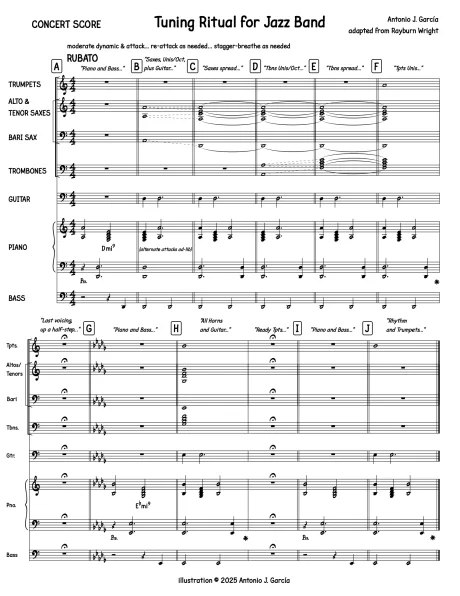
This process is aural, not written! Teach it by ear so students listen rather than look. See the example at the end of this article that captures one way it might play out. Think of each rehearsal letter shown as a cue to the band: synchronizing exact beats within measures is not important. When I work with the band, I call out events, not rehearsal letters.
I find the guitarist and bassist, often using clamped-on tuning devices as well as their ears, are already in tune by the time I start this process for the horns. If not, I give them a moment of horn-silence to accomplish this before I proceed. If you have a vibraphone in the band, add it to the process wherever you wish.
At letter A the piano plays a Dm9 chord, hitting A’s on top. The bassist repeatedly plays a low D. Letter B cues the saxes to tune unison/octave A’s; the guitar adds D’s. Take as long as the saxes need to get in tune! Once tuned, the saxes spread on my cue at letter C to a voicing of concert (bottom to top) D F (middle) C E A. At letter D the bones add unison A’s (perhaps bass bone on low A). Take as long as the bones need! Once tuned, then spread at letter E to notes F A (middle) C E. At letter F the trumpets add unison A’s. I don’t spread them. Once they are in tune, I cut off the band, then cue everyone to think about taking their last voicing up a half step.
At letter G (paralleling letter A), the piano and bass now play over an Ebm9 chord. On my cue at letter H, all horns and guitar take their last voicing up a half step (thus also an Ebm9 chord). The trumpets are now playing unison Bb’s. I don’t spread them. Once everyone is reasonably in tune, I cut off the band. At letter I (paralleling letter G), the piano and bass now repeat an Ebm9 chord. Letter J brings guitar to join the piano and bass, and the trumpets again add unison Bb’s.
I don’t spread the trumpets into voicings over the Dm9 or Ebm9 chords. If they aren’t in tune, I will request that each individual trumpet play its Bb in turn with the rhythm section (not shown in the illustration). I tell them this is not because the trumpets are necessarily the most out-of-tune instruments in the band but because they are usually the most noticeable horns in the band. I ask the rhythm section to play the Ebm9 chord again, and I cue one trumpet to play Bb.
Learning How to Tune
Then I ask the entire band to consider silently whether the trumpeter is in tune, sharp, or flat. After a moment of silence, I ask the player for an answer. It may be correct or not, and I state my answer; but by then all band members have been working their ears to discern it. This is critical to developing their skills to self-tune: instead of just tuning themselves, students are now tuning three to five trumpets, multiplying their tuning-experience while doing so.
Once I have reviewed each trumpeter separately with rhythm accompaniment, asking the band to consider silently, and offering my answer, two things typically become apparent in almost every student jazz band I have directed throughout the United States and beyond:
- On average, three of every four trumpets are sharp.
- Asked to pull out their tuning slides, they do it conservatively, resulting in little positive effect.
Most students are shocked by how far they must pull out (or occasionally push in) their slides or ligatures to get in tune. I remind all the winds that the audience does not notice their tuning slides and ligatures: audiences only hear our music. And I remind the horns that it is nearly impossible for a band to project a round, dark sound (when desired) while they are noticeably above the pitch!
By the second rehearsal, the challenge is afoot; and a game becomes rather fun. Can the trumpet section be in tune on the exposed unison pass of the section Bb’s (letter J)? After several rehearsals, the trumpet section is well-inspired to be in tune, eliminating the need for individual checks.
Effect
I would much rather spend ten minutes of the first rehearsal establishing great ensemble pitch than dive right into music that will be out of tune for hours. I would much rather give all band members the repeated challenge of determining a colleague’s tuning, developing tuning-skills several times faster than if focused solely on one’s own instrument. And by tuning the horns to the fifth of a minor chord, I have provided the band with what I believe is its best environment for rapid tuning success.
Resource
Observe a jazz ensemble utilizing this tuning ritual within the online expanded version of this article https://garciamusic.com/educator/articles/articles.html, where you can download a PDF of the illustration and experience an audio or video recording of it in live action. You’ll notice at the end of the process that I congratulate the trumpet section on being in tune at the first pass for three rehearsals in a row!
Antonio García is Former Director of Jazz Studies at Virginia Commonwealth University, freelanced with 70 major artists including Ella Fitzgerald, Louie Bellson, Dave Brubeck, and Phil Collins, and has led jazz residencies around the world. He is a Midwest Clinic Board Member, Brubeck Institute Past Advisory Board Member, Conn Selmer Institute Hall of Fame inductee, and recipient of The Midwest Clinic’s Medal of Honor.