






• Latest
  • Trending
Building Your Basic Woodwind Repair Skills in 2025

Building Your Basic Woodwind Repair Skills in 2025

February 24, 2025
Tone deaf – Decibel Scale

Tone deaf – Decibel Scale

January 29, 2026
Playing with Intent: The Missing Link Between Practice and Confidence

Playing with Intent: The Missing Link Between Practice and Confidence

January 27, 2026
Sweetwater
French Versus German? The Over/Under on Double Bass Bow Holds

French Versus German? The Over/Under on Double Bass Bow Holds

January 26, 2026
New Products – January 2026

New Products – January 2026

January 23, 2026
Minute Clinic – STUDENT CONDUCTORS

Minute Clinic – STUDENT CONDUCTORS

January 23, 2026
Top Music Education Titles for 2025

Top Music Education Titles for 2025

January 21, 2026
You Can Help Shape a Bold Future

You Can Help Shape a Bold Future

January 20, 2026
An Interview with Jeff Moore About Ralph Hardimon (Santa Clara Vanguard) and ‘Musica Boema”

An Interview with Jeff Moore About Ralph Hardimon (Santa Clara Vanguard) and ‘Musica Boema”

January 19, 2026
Step Up to 2026

Step Up to 2026

January 16, 2026
Principles for Building Stronger Classroom Systems

Principles for Building Stronger Classroom Systems

January 15, 2026
All the Small Moments

All the Small Moments

January 14, 2026
Ask a Conductor

Ask a Conductor

January 13, 2026
Saturday, January 31, 2026
  • Contact
SBO+
Yamaha Pro Audio
  • Subscribe Free!
    • Manage Subscription
  • Departments
    • Choral
    • String Section
      • String Section
    • Concert Band
    • Modern Band
      • Mariachi
    • Orchestra
    • Instruments
      • Woodwinds
        • Wind Talkers
      • Percussion
        • GoodVibes
      • Repertoire
      • Playing Tips
    • Marching Band
    • Resources
      • Fundraising
    • Jazz
    • Brass
    • General Music
    • Advocacy
      • NAfME Neighborhood
      • MAC Corner
      • MusicEd: Mentor Minute
    • Commentary
      • Bubbett’s Bookshelf
      • Leadership Tips
      • Perspective
      • InService
        • America’s Bandmasters
        • America’s Musicians
      • Tone Deaf Comics
    • Features
    • News
      • Headlines
  • Current Issue
    • Past Issues
  • Support
  • Awards/Entries
    • 50 Teachers Who Make a Difference
    • Teachers’ Choice Awards
  • Advertise
    • Email PR!
No Result
View All Result
  • Subscribe Free!
    • Manage Subscription
  • Departments
    • Choral
    • String Section
      • String Section
    • Concert Band
    • Modern Band
      • Mariachi
    • Orchestra
    • Instruments
      • Woodwinds
        • Wind Talkers
      • Percussion
        • GoodVibes
      • Repertoire
      • Playing Tips
    • Marching Band
    • Resources
      • Fundraising
    • Jazz
    • Brass
    • General Music
    • Advocacy
      • NAfME Neighborhood
      • MAC Corner
      • MusicEd: Mentor Minute
    • Commentary
      • Bubbett’s Bookshelf
      • Leadership Tips
      • Perspective
      • InService
        • America’s Bandmasters
        • America’s Musicians
      • Tone Deaf Comics
    • Features
    • News
      • Headlines
  • Current Issue
    • Past Issues
  • Support
  • Awards/Entries
    • 50 Teachers Who Make a Difference
    • Teachers’ Choice Awards
  • Advertise
    • Email PR!
No Result
View All Result
SBO+
No Result
View All Result

Building Your Basic Woodwind Repair Skills in 2025

bySBO Staff
February 24, 2025
in February 2025, Archives, Wind Talkers
0
Building Your Basic Woodwind Repair Skills in 2025
Share on Facebook
ADVERTISEMENT

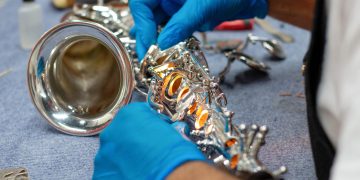
Over the next few months, in our WindTalkers column, we will be covering basic woodwind repair skills for saxophone, clarinet and flute. Our hope is to help you improve your knowledge to help your students become more aware of their abilities and the requirements for their instruments. If you are interested in taking it a step farther be sure to check out the Wind Repair Training Academy. (WindRepairTrainingAcademy.com). I am one of the teachers at the Academy.

Essential Saxophone Repair Skills Every Band Director Should Know
As a band director, you’re not just the leader of the ensemble. You’re also often the first line of defense when it comes to keeping instruments in playing condition. While you might not be expected to possess the deep technical knowledge of a professional repair technician, having a basic understanding of saxophone repair can be a game-changer for the smooth functioning of your program. The saxophone, like all wind instruments, is a delicate and intricate piece of machinery. Its numerous pads, springs, rods, and key mechanisms work together to produce a smooth, clear sound. However, wear and tear is inevitable, and saxophones are particularly prone to certain issues due to their complex construction and the unique demands placed on them by student players. Here are the fundamental skills every band director should be familiar with when it comes to saxophone maintenance and repair:

Diagnosing Leaks
A saxophone that isn’t sealing properly is an instrument that simply won’t play well, and it often leads to poor intonation or a fuzzy sound. Leaks usually occur when pads no longer create a complete seal over the tone holes. When a pad is damaged or worn out, air leaks through the gaps, reducing the instrument’s overall efficiency.
How to Diagnose Leaks: To check for leaks, use a ‘leak light’ – These can be simple, inexpensive LED strips or dedicated leak lights. Insert it into the instrument and while closing each key, look for light shining through, if there are leaks in the pads it will be obvious. There is a difference between pad leaks, and timing or adjustment leaks when two or more keys are supposed to close together. When checking for leaks try to do it one key at a time, and if there is a corresponding timing/adjustment leak. Press down on that pad with one hand, and then use your other hand to check the individual pad.
If the pad is heavily worn or damaged, you’ll need to replace it. While band directors may not have the tools or experience to do a full pad replacement, knowing when it’s necessary to send an instrument to a professional technician will save your students from playing a saxophone that they need to fight with to make music.

Springs
Springs control the movement of the saxophone’s keys, and over time, they can become weak or misaligned, causing keys to stick or not close fully. This issue typically manifests as keys that don’t pop back up when pressed. One of the most common things I have seen is springs that have just popped off their spring catch and the musicians just don’t notice it, often, just using a spring hook to put it back in place fixes many problems.
How to Fix It: While it’s often a good idea to leave spring replacements to the pros, a quick adjustment to a misaligned spring can often be done in a pinch. To adjust a spring, use a pair of needle-nose pliers to gently bend the spring to its correct position. This requires a delicate touch, as too much pressure can snap the spring or damage the surrounding components. Keep in mind that if the saxophone’s action is particularly sluggish or difficult, it might not be just the springs at fault—it could also be a combination of pads, rods, and alignment issues. So, if spring adjustments don’t fix the issue, don’t hesitate to get a more thorough professional evaluation.

Cleaning and Basic Maintenance
Regular cleaning and maintenance can prevent many of the problems mentioned above from occurring in the first place. Ensure your students wipe down their instruments after every use to remove moisture and oils that could damage the pads. Use a soft cloth for the body of the instrument, and a swab or pull-through for the neck and body tube. You can also get ‘pad dryers’ which is a small piece of microfiber cloth that helps to dry out pads individually. You can also get a product called ‘Key Leaves’ which prop open the Eb and C# keys, which subsequently opens the G# Key and will help the instrument to air out and help reduce that common ‘Sticky G#’.

Encourage students to check all their screws on their saxophone, especially the key guards as they can sometimes come loose from regular playing. I like to check all the screws on my saxophone at least once a month and gently tighten any screws that may back themselves out. If you go too far and the key no longer works, just a half turn backwards will solve that problem, most of the time, the screws will just naturally stop. It is also very important to use an end plug on a Saxophone every time it goes in the case. Many people just leave them sitting in the case and never  use them. The end plug is important to ensure the instrument stays securely in the case and doesn’t move in transit and keeps the octave key from getting damaged.

ADVERTISEMENT
ADVERTISEMENT

Final Thoughts
While saxophone repair may seem like a daunting task at first, learning these basic skills will give you the confidence to troubleshoot common issues and ensure that your students have reliable instruments for their musical journey. With a little practice and attention to detail, you’ll be able to keep your saxophones in working order, and your students’ music-making uninterrupted. After all, your role as a band director is about more than just teaching music—it’s about nurturing the instruments that bring that music to life.
Check out our video of Bruce Marking, former head of woodwind repair for Buffet Crampon, explaining some basic tips and tricks to help give you some more ideas of ways to maintain a saxophone.
https://www.youtube.com/watch?v=pP1n0GqbKOE

ADVERTISEMENT

LisasClarinetShop.com


You may also like:

2013 ’50 Directors Who Make a Difference’ Report Basic Clarinet Repair Skills and Tips for Band Directors SBO Presents the 21st Annual 50 Directors Who Make a Difference The 22nd Annual 50 Directors Who Make a Difference SBO Presents the 20th Annual 50 Directors Who Make a Difference
ADVERTISEMENT
Previous Post

TI:ME Announces Free PreSonus Revelator USB Microphone at 30th Anniversary Celebration at TMEA

Next Post

The Three-Quarter-Time Maestro: André Rieu and His Vision for Waltzes in Music Education

Next Post
The Three-Quarter-Time Maestro: André Rieu and His Vision for Waltzes in Music Education

The Three-Quarter-Time Maestro: André Rieu and His Vision for Waltzes in Music Education

Please login to join discussion
  • January 2026

    Articles | Digital Issue
  • December 2025

    Articles | Digital Issue
  • November 2025

    Articles | Digital Issue
  • October 2025

    Articles | Digital Issue
  • September 2025

    Articles | Digital Issue
© 2005 - 2026 artistpro, LLC
7012 City Center Way, Suite 207
Fairview, Tennessee 37062
(800) 682-8114

Wenger Endur Music Stand
No Result
View All Result
  • Subscribe Free!
    • Manage Subscription
  • Departments
    • Choral
    • String Section
      • String Section
    • Concert Band
    • Modern Band
      • Mariachi
    • Orchestra
    • Instruments
      • Woodwinds
      • Percussion
      • Repertoire
      • Playing Tips
    • Marching Band
    • Resources
      • Fundraising
    • Jazz
    • Brass
    • General Music
    • Advocacy
      • NAfME Neighborhood
      • MAC Corner
      • MusicEd: Mentor Minute
    • Commentary
      • Bubbett’s Bookshelf
      • Leadership Tips
      • Perspective
      • InService
      • Tone Deaf Comics
    • Features
    • News
      • Headlines
  • Current Issue
    • Past Issues
  • Support
  • Awards/Entries
    • 50 Teachers Who Make a Difference
    • Teachers’ Choice Awards
  • Advertise
    • Email PR!

© 2005 - 2024 artistpro, LLC 7012 City Center Way, Suite 207 Fairview, Tennessee 37062 (800) 682-8114