










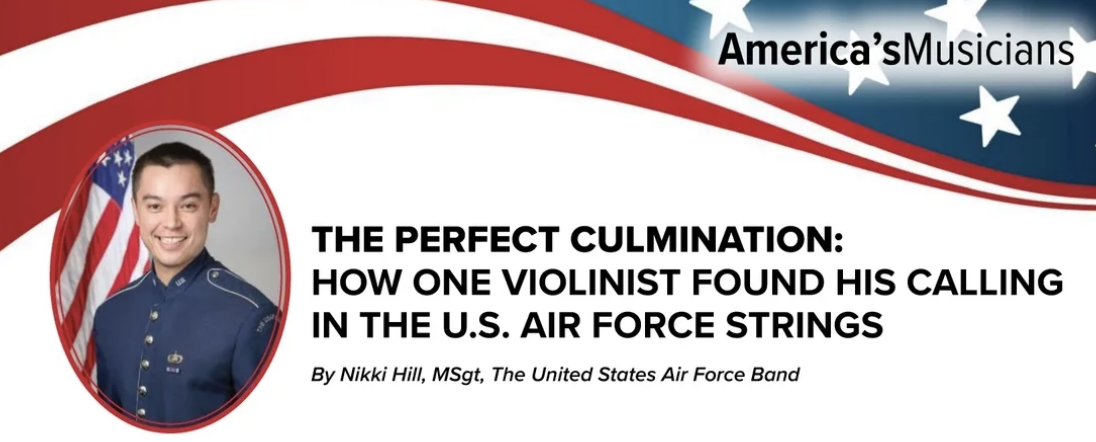

By Nikki Hill, MSgt, The United States Air Force Band
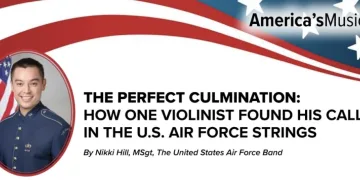
Upon meeting Technical Sergeant Michael Romans, the first thing you notice is his bright smile and easygoing demeanor — and the sense of love for the life he leads. “I started playing violin when I was ten years old,” he recalls with a laugh. “My parents told me it would either be violin or viola, because those would fit easily on a school bus!”
Growing up in the Fairfax County Public School System in Virginia, he was surrounded by music and a sense of service. His brother played viola, his father is a clarinetist and saxophonist, who still performs with a local community band, and his grandfather was a musician with the Army’s 3rd Armored Division Band. “Music and service were always intertwined in our family,” he says. “So, when I eventually joined the Air Force Strings, it really felt like it was meant to be.”
From the beginning, that foundation of mentorship and culture shaped his musical journey. He credits his earliest teachers — Mary Wagner, his fourth-grade music teacher; Stephanie Holmes and Beth Reid through middle and high school; and his private violin instructor, Jim Batts — with inspiring him to eventually pursue music seriously. “I was the kid who never had to be told to practice. They were guiding voices when I decided to pursue music in college,” he explains. “They helped me see all the possibilities in shaping my career to something beyond just performing.”
Their guidance carried him through the academic demands of college life. At Indiana University, he pursued a dual major, focusing on a Bachelor of Music in violin performance from the Jacobs School of Music, alongside a business degree from the Kelley School of Business. “It was a lot,” he admits, “but it was worth it. Having both degrees gave me balance, and it taught me discipline.”
After earning his Bachelor’s, he took a gap year before pursuing a Master’s in violin performance from the University of Michigan. It was there that he began to question the next steps of his career. “Going for the Doctorate was the original trajectory, but then I pivoted to taking auditions.” That was in 2020, the year COVID halted everything.
“When the pandemic hit, many opportunities suddenly disappeared,” he recalls. “That’s when I decided to commit to a Doctorate and to win an audition.” He began taking auditions while working on his doctoral coursework, determined to turn a period of uncertainty into a path forward.
Before long, that persistence paid off. At the time, he had already established himself as a serious violinist. He was the soloist for the Bruch Violin Concerto with the National Repertory Orchestra and served as concertmaster for Rimsky-Korsakov’s Scheherazade with the Adrian Symphony. He was also newly appointed to the Virginia Symphony. Life was good, and he was settling into this chapter of life. A conversation with his brother, a current officer in the Air Force, motivated him to audition. “He said, ‘You have to do it!’” he laughs. “So, I did.”
The audition day is one he’ll never forget. “I get chills thinking about it,” he says. “There were more than 60 candidates, and it was an all-day process. We started at 7 a.m., and by the finals there were only five of us left. I didn’t leave the building until 9 p.m.” Despite the long hours and the pressure, he recalls a sense of calm. “It was very much a ‘live and let go’ feeling. When they announced my name as the winner, I was so relieved! It was an incredible moment.”
For him, joining a military band wasn’t just a career move, it was a calling. “Everyone in my family has served in some way,” he says. “Both my parents were officers in the Army. My grandfather was in the Army-Air Corps during World War II, and my other grandfather was a musician for the Army. My brother’s in the Air Force. I grew up surrounded by both music and military culture. Winning a job with the Air Force Strings felt like destiny — the perfect culmination of all the worlds that shaped me.”
Now, as a member of the U.S. Air Force Strings in Washington, D.C., he finds daily inspiration in the variety and purpose of his work. “It’s always exciting,” he says. “Things are constantly changing. Within my first year, I’ve had opportunities to solo with the group, record videos, and perform at events at the White House and the State Department. It’s incredible — what other job lets you do that?”
The ensemble’s demanding repertoire and memorization requirements presented an adjustment, but years of training helped him rise to the challenge. “After basic military training, I had to get back in shape musically,” he says. “Everyone in the group has been so kind and supportive.”
Even as he performs for dignitaries and high-ranking officials, he remains grounded in what brought him here: family, artistry, and a shared sense of service. “Being part of the Air Force Strings has reignited my passion for music,” he reflects. “I can’t think of too many careers that let you do what we do, and in many ways our impact and capabilities feel limitless,” he says. “Every performance is different. Every day brings new opportunities. I’m just really, really happy to be here.”